






Newsletter Subscribe
Enter your email address below and subscribe to our newsletter

Enter your email address below and subscribe to our newsletter
All voices matter
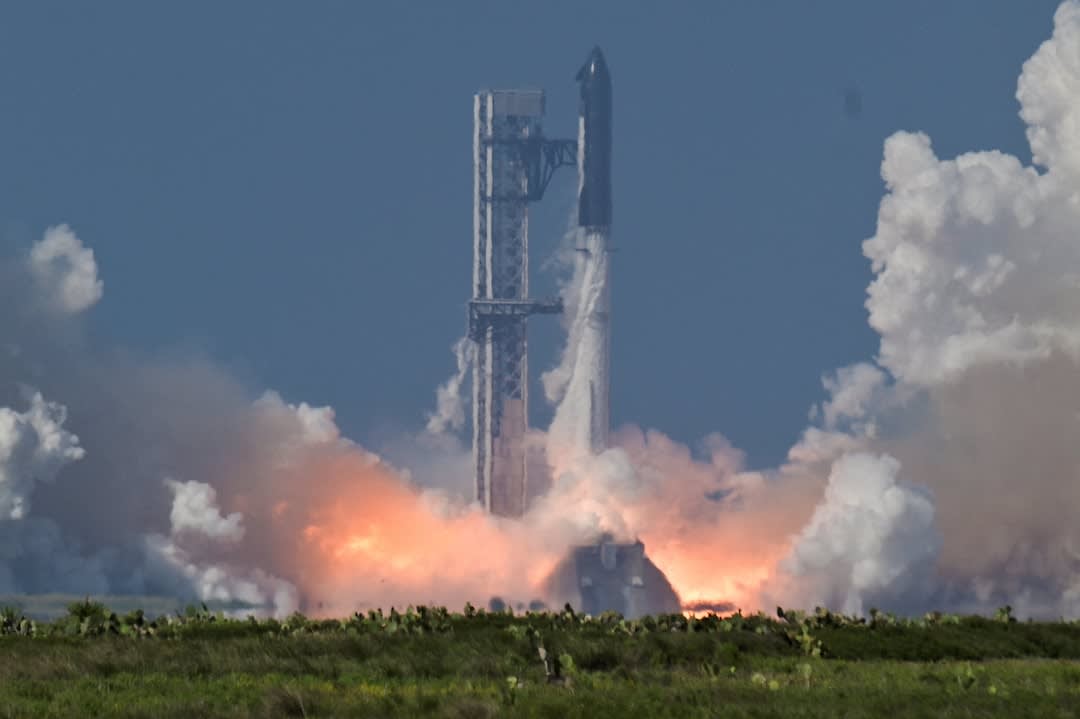
SpaceX launched its upgraded Starship V3 megarocket on Friday evening from Starbase, Texas, marking the debut of the company’s most powerful rocket design yet. While the upper stage successfully deployed 22 dummy Starlink satellites and completed a controlled splashdown in the Indian Ocean, the Super Heavy booster crashed uncontrolled into the Gulf of Mexico after its engines failed to perform as planned.
The flight, which lifted off at 5:33 p.m. CDT from SpaceX’s new Pad 2, came one day after a hydraulic pin on the launch tower arm failed to retract, scrubbing the first attempt at T-minus 40 seconds. Upper-level winds pushed the launch from its initial 5:30 p.m. window to 6:30 p.m. CDT on Friday.wikipedia
The 12th test flight of the fully integrated Starship system produced mixed results. One of the Super Heavy booster’s 33 Raptor engines shut down during ascent at about T+1:42. After stage separation, only five of the booster’s engines relit for its boostback burn, which ended prematurely. During the landing burn attempt, just one engine fired, and the booster hit the Gulf of Mexico at roughly 1,450 km/h.space
SpaceX had not planned to recover the booster on this flight, instead targeting a simulated landing over open water. The company’s spokesperson Dan Huot called the Ship’s trajectory “within bounds” despite the engine loss, and the vehicle burned its remaining five engines longer to compensate.nytimes
Ship 39, the Starship upper stage, reached space and successfully deployed all 22 dummy Starlink satellites — 20 mass simulators and two modified “Dodger Dogs” equipped with cameras to photograph the heat shield. SpaceX canceled a planned Raptor in-space relight experiment due to the engine-out condition during ascent. After coasting for roughly 40 minutes, Ship 39 reentered the atmosphere and executed a landing flip and splashdown in the Indian Ocean about one hour and six minutes after liftoff.wikipedia
The test comes at a pivotal moment for SpaceX. The company filed its prospectus with the SEC on May 20 and is targeting a June 12 listing on the Nasdaq under the ticker SPCX, in what could be the largest IPO in history at a valuation of $1.75 trillion to $2 trillion. NASA Administrator Jared Isaacman attended the launch, underscoring Starship’s role as the planned lander for NASA’s Artemis 4 moon mission. SpaceX also needs the rocket operational to begin deploying its next-generation Starlink internet satellites at scale.reuters