





Newsletter Subscribe
Enter your email address below and subscribe to our newsletter

Enter your email address below and subscribe to our newsletter
All voices matter
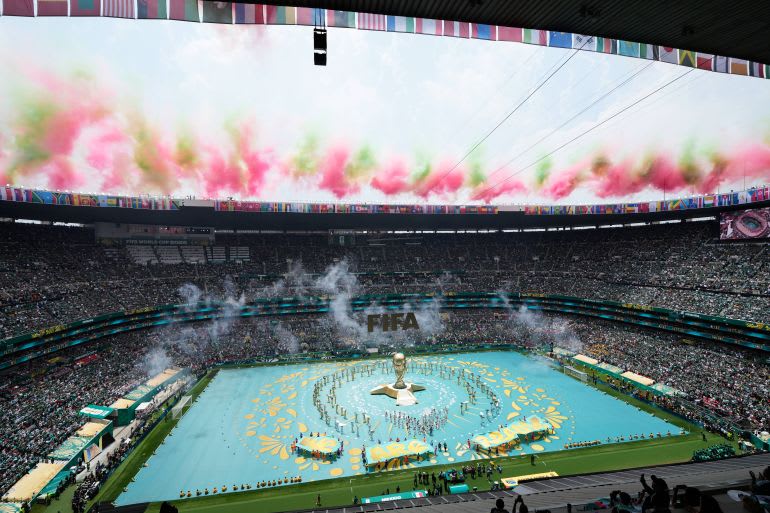
The 2026 FIFA World Cup, the largest in history with 48 teams competing across 16 cities in three countries, opened on June 11 with ceremonies in Mexico City and continues Friday with events in Toronto and Los Angeles. But behind the fanfare, this tournament is unfolding against an economic and geopolitical backdrop that BBC economics editor Faisal Islam has called “the craziest World Cup ever.”bbc
The co-hosts — the United States, Canada, and Mexico — face a July 1 deadline for the mandatory six-year review of the United States-Mexico-Canada Agreement, the free trade pact governing commerce across North America. The review carries real stakes: if any party declines to confirm renewal, the agreement enters a countdown toward expiration in 2036.whitecase
The U.S. Trade Representative’s office announced in late May that it would hold three bilateral negotiating rounds with Mexico — without Canada — beginning May 28-29 in Mexico City, followed by a June 16-17 session in Washington and a third round the week of July 20. According to Reuters, U.S. Trade Representative Jamieson Greer indicated the United States intends to maintain certain tariffs on Mexican and Canadian goods. Canada, meanwhile, formally requested renewal of the agreement on June 2, with trade minister Dominic LeBlanc calling for a 16-year extension. Mexico has also expressed its intent to extend the deal.ustr
The spectacle of three nations jointly hosting a celebration of international unity while simultaneously locked in trade disputes has drawn wide commentary.
The geopolitical complexity extends to the pitch. Iran, which qualified for its fourth consecutive World Cup, will compete in Group G against New Zealand, Belgium, and Egypt despite months of uncertainty following U.S. military strikes on Iranian nuclear sites last year. Iranian players received U.S. visas in early June after applying through the American embassy in Turkey, though ESPN reported that 14 members of Iran’s broader delegation were denied entry.bbc
FIFA said on June 9 it was working to “maximise opportunities for Iranian supporters to attend matches” after the country’s group-stage ticket allocation was revoked days before the tournament. A potential U.S.-Iran knockout-stage clash remains plausible if both teams advance, a scenario that analysts at the Center for Strategic and International Studies noted would be one of four adversarial pairings in the tournament — the most in World Cup history by raw count.trtworld
The tournament’s ticketing system has also drawn scrutiny. FIFA’s official resale marketplace charges a 15 percent fee to both buyers and sellers on all relisted tickets, effectively taking a 30 percent cut from each transaction. With World Cup final tickets listed at prices exceeding $2 million on the platform, the commission structure has frustrated fans. Average resale prices for U.S.-hosted matches stood at $558 in mid-May after falling 23 percent over the prior month, according to Forbes.reddit
A FIFA and World Trade Organization study estimated the tournament could add roughly $41 billion to global GDP and support more than 800,000 jobs worldwide.youtube