







Newsletter Subscribe
Enter your email address below and subscribe to our newsletter

Enter your email address below and subscribe to our newsletter
All voices matter
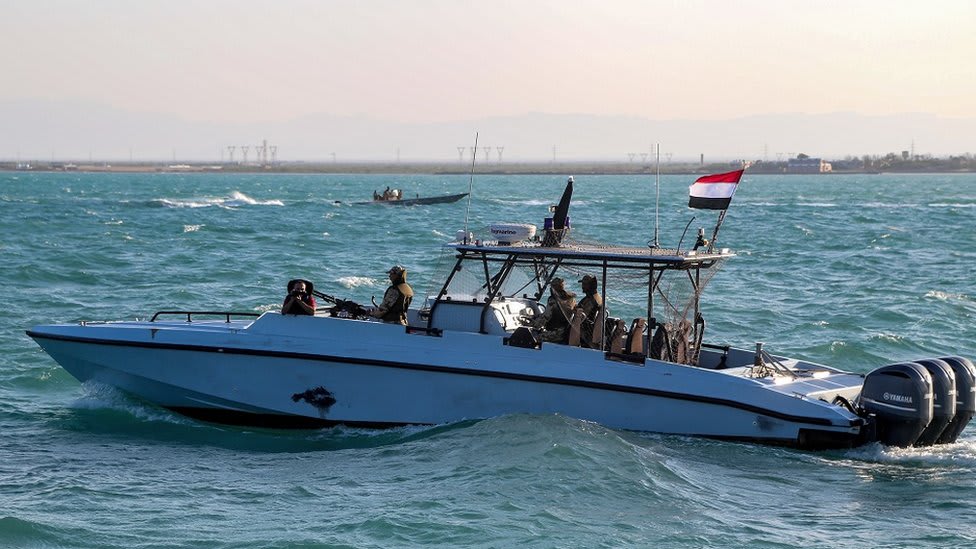
Yemen’s Houthi forces declared a “complete and total ban” on Israeli maritime navigation in the Red Sea on Monday, June 8, backing the announcement with missile strikes on two commercial vessels in the Gulf of Aden within hours. The escalation comes on the 100th day of the Iran war and the closure of the Strait of Hormuz, compounding the disruption to global energy markets and threatening Saudi Arabia’s only functioning crude export corridor.
Brigadier General Yahya Saree, the Houthi military spokesman, announced the ban in a televised address: “We declare a complete and total ban on Israeli maritime navigation in the Red Sea, and we consider all enemy movements to be legitimate military targets for our armed forces from the moment the statement is issued.” A Houthi source told Reuters that preventing Israeli ships from transiting the Red Sea was a “first step” and that further escalation could follow.gcaptain
Hours later, Houthi forces struck the M/V Tavvishi, a Liberian-flagged container ship, with an anti-ship ballistic missile in the Gulf of Aden. The M/V Norderney, a German-operated cargo vessel, was hit by both a ballistic and cruise missile. Both vessels sustained damage but continued under their own power, with no injuries reported. U.S. Central Command confirmed the attacks and said American forces destroyed one unmanned aerial system, two land-attack cruise missiles, and a missile launcher in Houthi-controlled Yemen on June 9.houseofsaud
The strikes carry direct implications for Saudi Arabia. With the Strait of Hormuz effectively closed since early March following U.S.-Israeli strikes on Iran, Saudi Aramco has routed crude at maximum capacity through its East-West Pipeline to the Yanbu terminal on the Red Sea — handling roughly 7 million barrels per day. But an estimated 70–75 percent of that crude destined for Asian buyers in Japan, South Korea, and India must transit Bab el-Mandeb, the strait that Houthi forces now patrol with demonstrated reach.factcheck
The South China Morning Post reported in April that Houthi threats to sever the Bab el-Mandeb route would “effectively sever Saudi Arabia’s only remaining oil export route.” Saudi Arabia has issued no public statement addressing Houthi maritime operations throughout the current conflict.scmp
Sunday marked the centenary of the U.S.-Israel conflict with Iran, which CNBC reported “continues to generate considerable instability across various asset classes globally.” The Strait of Hormuz has been closed since March 2, according to CSIS, and despite a brief Iranian announcement of reopening on April 17, the Islamic Revolutionary Guard Corps reversed course a day later.cnbc
British maritime risk management group Vanguard assessed Monday that the Houthi declaration was “directed at vessels assessed by the Houthis as Israeli-affiliated” rather than a blanket ban on all commercial traffic. But the targeting criteria have expanded: Saree stated both vessels were struck because their operating companies had made port calls in Israel — a corporate-level standard that could encompass tankers chartered by international operators carrying Saudi crude.marinelink
The commercial consequences may outweigh the kinetic damage. War risk premiums in the earlier 2024–25 Houthi campaign reached approximately 3 percent of vessel value, and BIMCO warned on June 8 that vessels with Israeli or U.S. business connections would “likely struggle to obtain cover at any price” if attacks resumed. The pattern from 2024, when container traffic through the Red Sea fell roughly 90 percent, was driven not by ships sinking but by insurers withdrawing coverage.houseofsaud