




Newsletter Subscribe
Enter your email address below and subscribe to our newsletter

Enter your email address below and subscribe to our newsletter
All voices matter
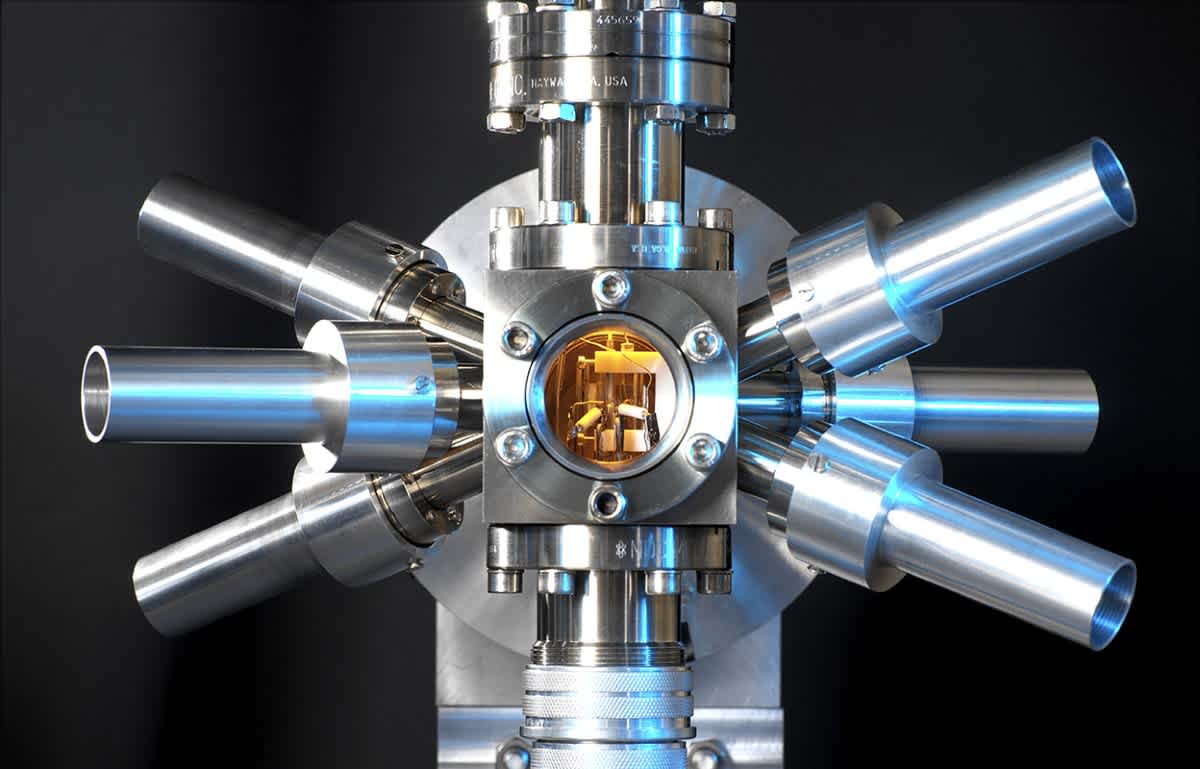
After more than two decades of effort, two independent research groups have built the first functioning nuclear clocks — devices that keep time by measuring oscillations within an atomic nucleus rather than its surrounding electrons. The parallel breakthroughs, reported in preprints posted to arXiv in early June, mark the transition of nuclear timekeeping from theoretical aspiration to working technology.
The European team, led by physicist Thorsten Schumm at TU Wien in Austria, and a Chinese team anchored at Tsinghua University under Shiqian Ding and first-author Beichen Huang, each stabilized a vacuum ultraviolet laser to the 148-nanometer nuclear transition in thorium-229 nuclei embedded in calcium fluoride crystals. Both groups implemented feedback loops that continuously steer the laser frequency to match the nuclear resonance — a step that distinguishes an operational clock from mere spectroscopy.arxiv
“This was the final missing step before calling it an actual clock,” Lars von der Wense, a physicist at Johannes Gutenberg University Mainz who was not involved in either project, told Science News.gizmodo
The Tsinghua-led team achieved a fractional frequency instability of 2 × 10⁻¹² per square root of the averaging time in seconds, reaching roughly 2 × 10⁻¹⁴ over extended operation. The Vienna team reported instability of 3 × 10⁻¹² per square root of the averaging time, approaching 10⁻¹⁵ over a full day of continuous, unattended operation. Both operate at or near room temperature, without the extreme cooling or vacuum systems required by today’s leading atomic clocks.arxiv
An atomic nucleus is roughly 10,000 times smaller than the electron cloud that surrounds it, making it far less susceptible to disturbances from electric fields, temperature fluctuations, and other environmental noise. That resilience could eventually yield clocks of unmatched stability — compact enough for field deployment yet precise enough to test whether the fundamental constants of physics drift over time.gizmodo
The Vienna group immediately put its clock to work searching for ultralight dark matter, reporting that the device already outperforms atomic clocks in constraining how dark matter might couple to the strong nuclear force and to quarks. The enhanced sensitivity stems from thorium-229’s nuclear transition being thousands of times more responsive to changes in the fine-structure constant than the electronic transitions used in conventional atomic clocks.nih
Both teams acknowledged that the current devices do not yet match the raw precision of the world’s best optical atomic clocks, which reach fractional uncertainties below 10⁻¹⁸. But the pace of improvement has been swift. As recently as March, nearly a dozen groups across China, Europe, Japan, and the United States were racing to assemble the necessary components. The Vienna team’s own 2024 work first located the thorium resonance; now, barely two years later, a working clock exists.nature
“What impressed me the most was that the system operated continuously for 24 hours without user intervention,” said Ekkehard Peik of Germany’s national metrology institute PTB, a co-author on the European paper.newscientist