







Newsletter Subscribe
Enter your email address below and subscribe to our newsletter

Enter your email address below and subscribe to our newsletter
All voices matter
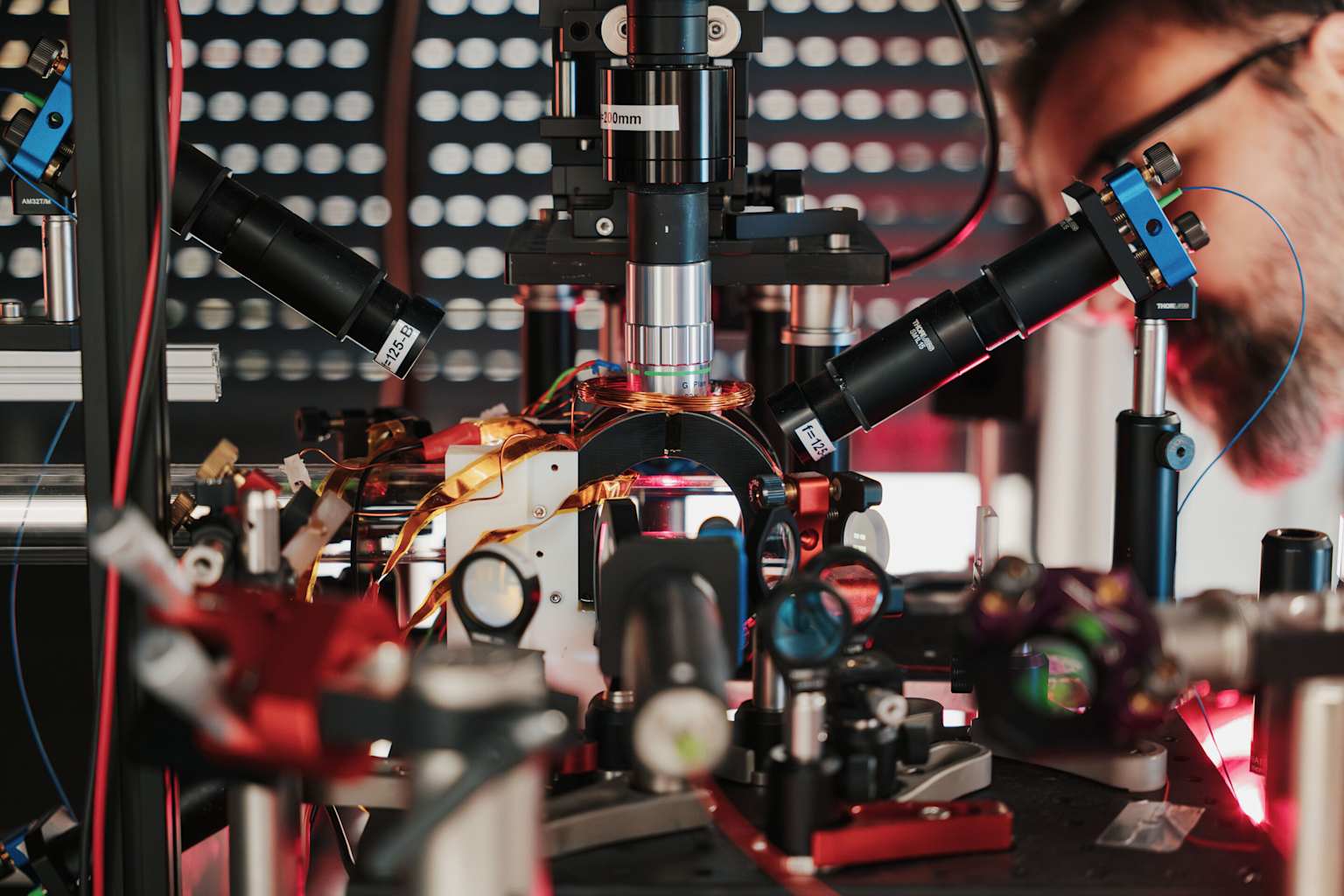
A physicist at the University of Birmingham has constructed a quantum “mini-universe” from ultracold atoms that measures the passage of time without any external clock — offering the first controlled experimental evidence that time can emerge from within an isolated system.
Professor Giovanni Barontini cooled roughly 24,000 rubidium atoms to a few billionths of a degree above absolute zero, then split the resulting quantum cloud in two using a wall of laser light. One half — the “bright” sector — could be observed, while the other remained a hidden “dark” sector. Atoms leaked back and forth across the laser barrier, and it was precisely this traffic of particles that served as the system’s internal clock.phys
The bright sector swells outward until it reaches a maximum, then contracts and collapses back — a tiny Big Bang followed by a Big Crunch — with the whole cycle playing out in about a tenth of a second. When the spread of atoms changes, time moves forward. When nothing spreads, time stops. No external second-hand is required.scienceblog
Publishing his findings in Physical Review Research, Barontini showed that this “entropic time” flows in one consistent direction, providing a clear arrow from past to future. It correctly orders events even as the system expands and contracts, and it speeds up or slows down depending on how briskly entropy moves between the two sectors. When the laser barrier is raised high enough, entropy exchange dwindles toward nothing and the mini-universe drifts toward a “heat death” in which entropic time grinds to a halt.arxiv
“This study provides the first controlled experimental evidence that ‘time’ can be defined by changes within a system rather than as the external ‘ticking clock’ we think of as time,” Barontini said, adding that the approach “could be used to describe dynamics just as effectively as conventional time”.phys
The experiment draws on the same mathematics used to describe toy universes in quantum cosmology, meaning abstract cosmic questions about time and gravity can now be probed in a real laboratory. As New Scientist reported, the work suggests time might emerge from quantum interactions rather than existing as an inherent feature of reality. The system is an analogue rather than a literal cosmos, but it opens a controlled testbed for theories that have until now remained purely theoretical — bridging quantum gravity and laboratory physics in a glass chamber in Birmingham.newscientist