






Newsletter Subscribe
Enter your email address below and subscribe to our newsletter

Enter your email address below and subscribe to our newsletter
All voices matter
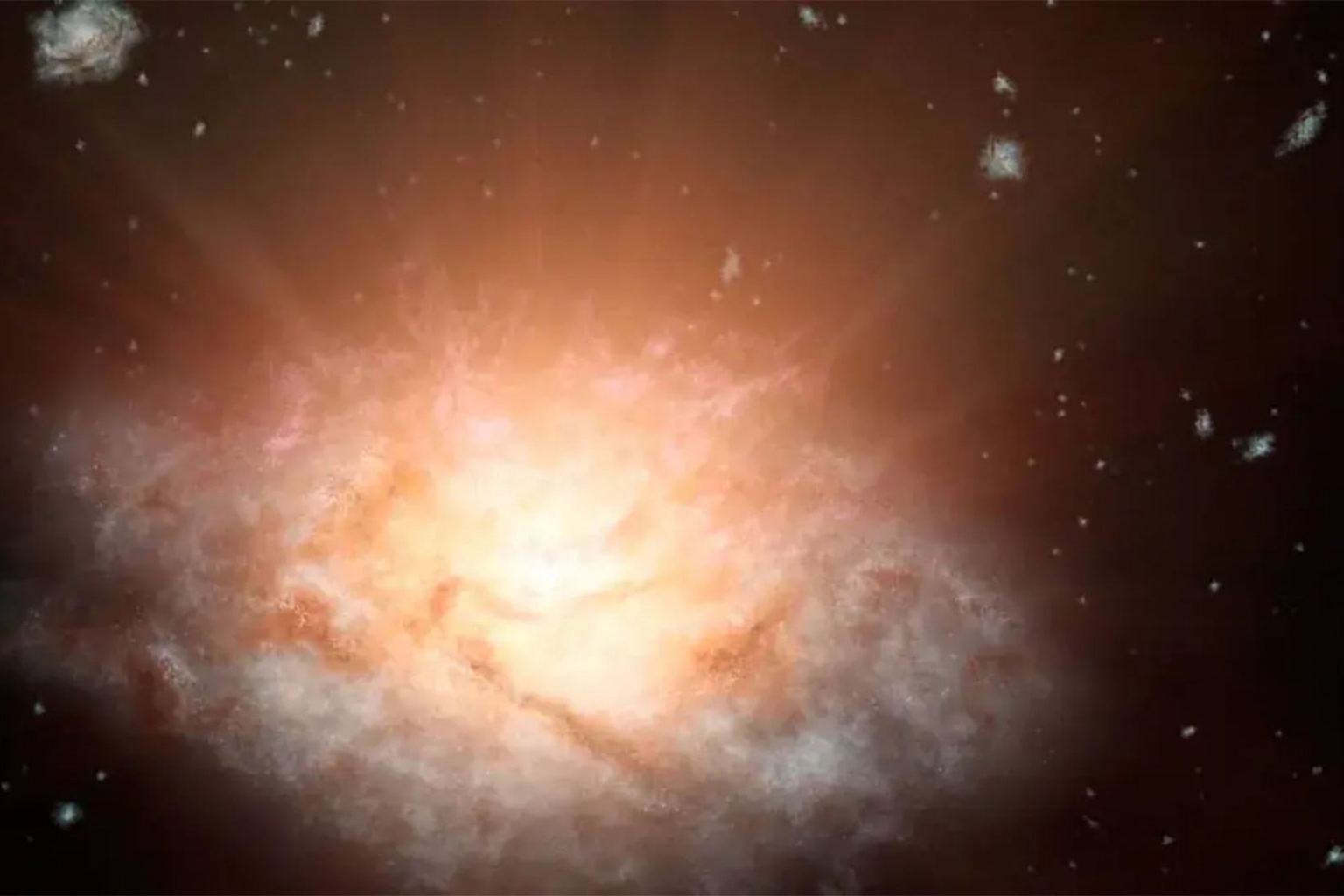
The James Webb Space Telescope has detected a stellar bar — a structure long thought to require billions of years to form — inside a galaxy that existed just 1.5 billion years after the Big Bang, upending key assumptions about how galaxies develop in the early universe.
A team led by Leindert A. Boogaard of Leiden University used JWST’s mid-infrared and near-infrared instruments to peer through the dust shrouding GN20, a massive, gas-rich galaxy at redshift 4.055. Their isophotal analysis revealed a stellar bar spanning seven kiloparsecs from end to end — comparable in size to the bar in our own Milky Way.phys
The finding, submitted to arXiv on May 14, 2026, represents the earliest direct detection of a stellar bar in a galaxy with confirmed, abundant gas reserves. According to standard models of galaxy evolution, bars form slowly over billions of years and should be suppressed or delayed in gas-rich environments. GN20 violates all three conventional constraints: its bar is too strong, too large, and formed despite the presence of abundant gas.skycr
“Our new results demonstrate that all three of these obstacles can be overcome by a single ingredient directly implicated by the observations: the presence of highly turbulent gas across the inner disk at high gas fraction,” the team writes.phys
The detection was confirmed independently through separate mathematical analysis and aligns with a bar-shaped dust feature observed by the NOrthern Extended Millimeter Array. The researchers propose that GN20, despite its gas richness, is already a baryon-dominated system — one in which the combined mass of stars, gas, and dust exceeds the contribution of dark matter within the galactic disk. In that gravitational regime, disk instabilities can grow rapidly enough to produce a bar on far shorter timescales than secular evolution predicts.skycr
The bar appears to be actively funneling gas inward, fueling a nuclear starburst and possibly feeding a supermassive black hole, driving GN20’s extraordinary star formation rate of over 1,000 solar masses per year.phys
The discovery may also explain a longstanding puzzle: how the massive, dead elliptical galaxies observed in the present-day universe quenched their star formation so early. Once a bar-driven system exhausts its gas supply, it would rapidly go quiet. The finding adds to a growing body of JWST evidence — including a recently discovered non-rotating massive galaxy and ancient barred spiral COSMOS-74706 — that the early universe was building mature galactic structures far faster than current models anticipated.sciencedaily