Newsletter Subscribe
Enter your email address below and subscribe to our newsletter
Enter your email address below and subscribe to our newsletter

All voices matter
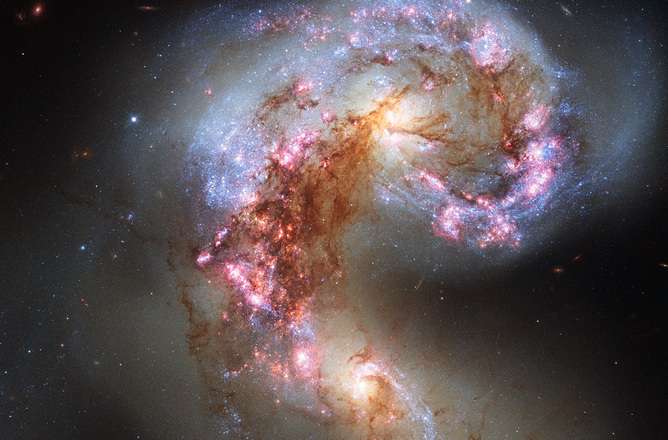
Astronomers using NASA’s Hubble Space Telescope have detected ultraviolet light escaping from a galaxy that existed just 1.4 billion years after the Big Bang — a finding once considered impossible. The discovery, published on Monday in the Astrophysical Journal, offers the clearest picture yet of how early galaxies transformed the opaque universe into the transparent cosmos visible today.stsci
The galaxy, cataloged MXDFz4.4, is the earliest known source of escaping ionizing photons, the high-energy ultraviolet light capable of stripping electrons from hydrogen atoms. It existed during the tail end of the Era of Reionization, when the universe was transitioning from a dense fog of neutral hydrogen gas into a clear, ionized state.nasa
“Observing a galaxy like this was thought to be impossible,” said lead author Ilias Goovaerts, a postdoctoral fellow at the Space Telescope Science Institute in Baltimore. “Researchers expected the ‘fog’ or neutral hydrogen that filled the early universe would be too thick and obscure our view of its ionizing light.”nasa
Despite being about 100 times smaller than the Milky Way, MXDFz4.4 was forming stars 10 times faster. Its young, massive stars were tightly packed together, and the team estimates that 50 to 100 percent of their ionizing light was escaping the surrounding gas. Many of these short-lived stars also exploded as supernovae, blowing holes that allowed even more light to pass through.youtube
Because the ultraviolet light stretched into visible wavelengths over more than 12 billion years of cosmic expansion, Hubble’s wavelength coverage and space-based resolution make it the only telescope capable of capturing it. “Hubble returned the only view that shows the galaxy’s ionizing photons — light capable of clearing the ‘fog’ in and around the galaxy,” Goovaerts said.stsci
NASA’s James Webb Space Telescope and the European Southern Observatory’s Very Large Telescope provided supporting data. Webb helped the team analyze the galaxy’s older stellar population and measure its star formation history, while the VLT pinpointed when MXDFz4.4 existed. Combined Hubble and Webb imagery confirmed that recent star formation occurred in bursts, with younger stellar populations responsible for clearing the surrounding gas.nasa
Before this discovery, the earliest known galaxy emitting ionizing light dated to when the universe was 1.6 billion years old. MXDFz4.4 pushes that boundary back by roughly 200 million years, bringing researchers closer to understanding how the Era of Reionization unfolded.nasa
“Hubble’s observations of MXDFz4.4 let us test our hypotheses much closer to the Era of Reionization than ever before,” said Marc Rafelski, Hubble deputy mission head at STScI and a co-author on the paper. “Finding more galaxies, especially at slightly later cosmic times where larger samples are within reach, would let us refine these measurements and figure out what cleared our view as that era was ending.”nasa