





Newsletter Subscribe
Enter your email address below and subscribe to our newsletter

Enter your email address below and subscribe to our newsletter
All voices matter
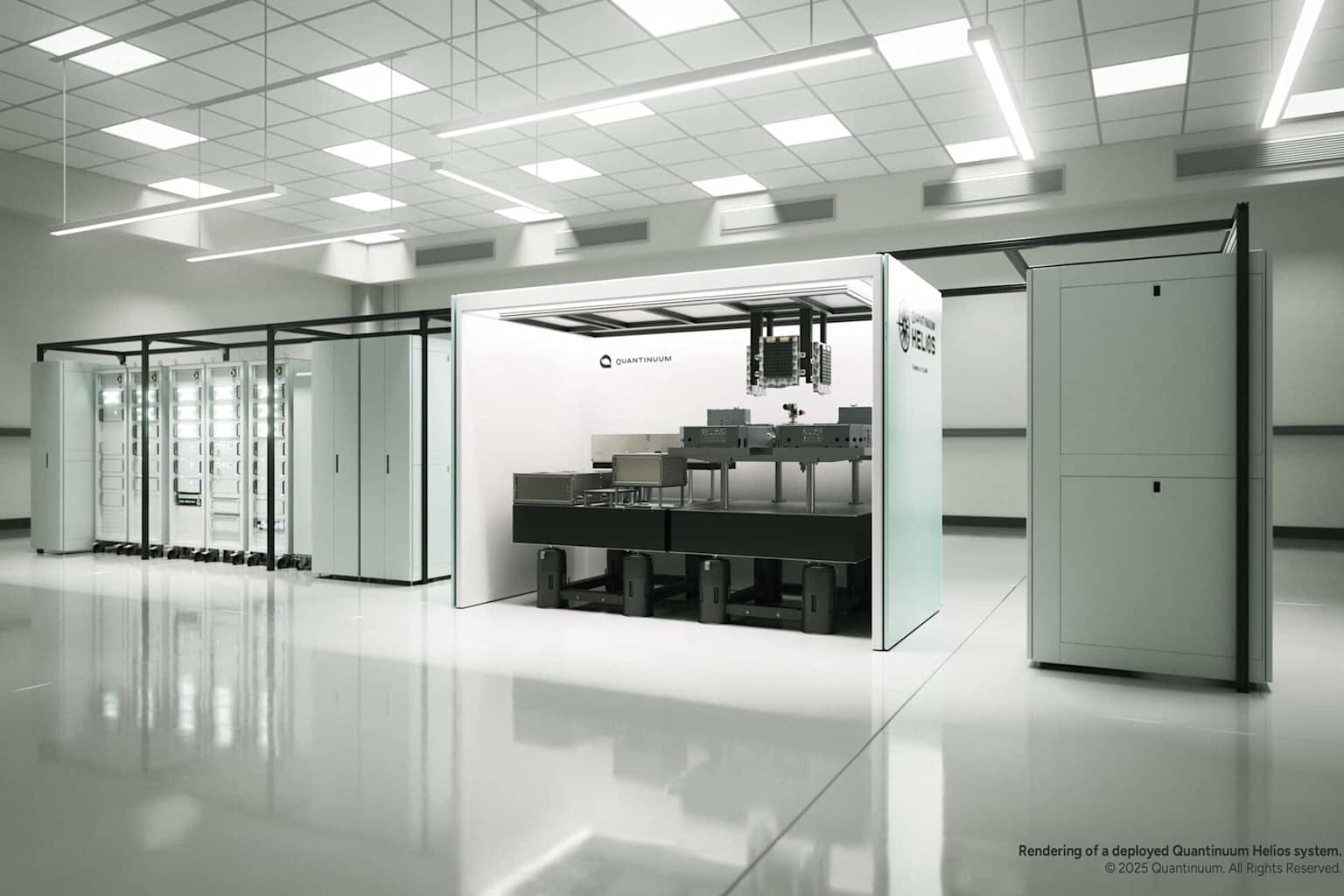
Quantinuum and Sandia National Laboratories have published peer-reviewed results in Nature demonstrating that Helios, a 98-qubit trapped-ion quantum computer, operates well beyond the reach of classical simulation while maintaining the highest gate fidelities of any commercial quantum system.nature
The paper, published on June 17, reports single-qubit gate fidelity of 99.9975% and two-qubit gate fidelity of 99.921% averaged across all operational zones in the system — figures that surpass competing superconducting platforms from Google and IBM. The system uses barium-137 hyperfine qubits and achieves state preparation and measurement infidelity of just 4.8 × 10⁻⁴.arxiv
“You would need to harvest every sun in the universe to power a classical machine that could reproduce what we did on Helios,” said a Quantinuum researcher, referencing the system’s performance in random circuit sampling benchmarks that establish “a new frontier of fidelity and complexity for quantum computers.”linkedin
Helios is built on a Quantum Charge-Coupled Device (QCCD) architecture featuring a “tuning fork” ion trap design with a rotatable ion storage ring connecting two quantum operation regions via a junction. This enables all-to-all qubit connectivity — meaning any two qubits in the system can interact directly — a property that distinguishes trapped-ion systems from the fixed-grid topology of superconducting processors.nature
The system also encodes up to 48 fully error-corrected logical qubits at a 2:1 physical-to-logical ratio, and up to 94 error-detected logical qubits with performance exceeding that of raw physical qubits.quantumcomputingreport
Sandia National Laboratories independently validated Helios’s performance through rigorous benchmarking, a partnership that supports the U.S. Department of Energy’s goal of achieving fault-tolerant quantum computing. Separate work using Europe’s JUPITER exascale supercomputer confirmed that Helios maintains coherent performance up to 93 qubits and over 12,000 two-qubit gates before outputs become indistinguishable from noise.hpcwire
The results position Helios as the first 100-qubit-scale trapped-ion system to demonstrate that the technology can match superconducting circuits in qubit count while maintaining lower error rates — a milestone in the competition between quantum hardware platforms.quantumzeitgeist