







Newsletter Subscribe
Enter your email address below and subscribe to our newsletter

Enter your email address below and subscribe to our newsletter
All voices matter
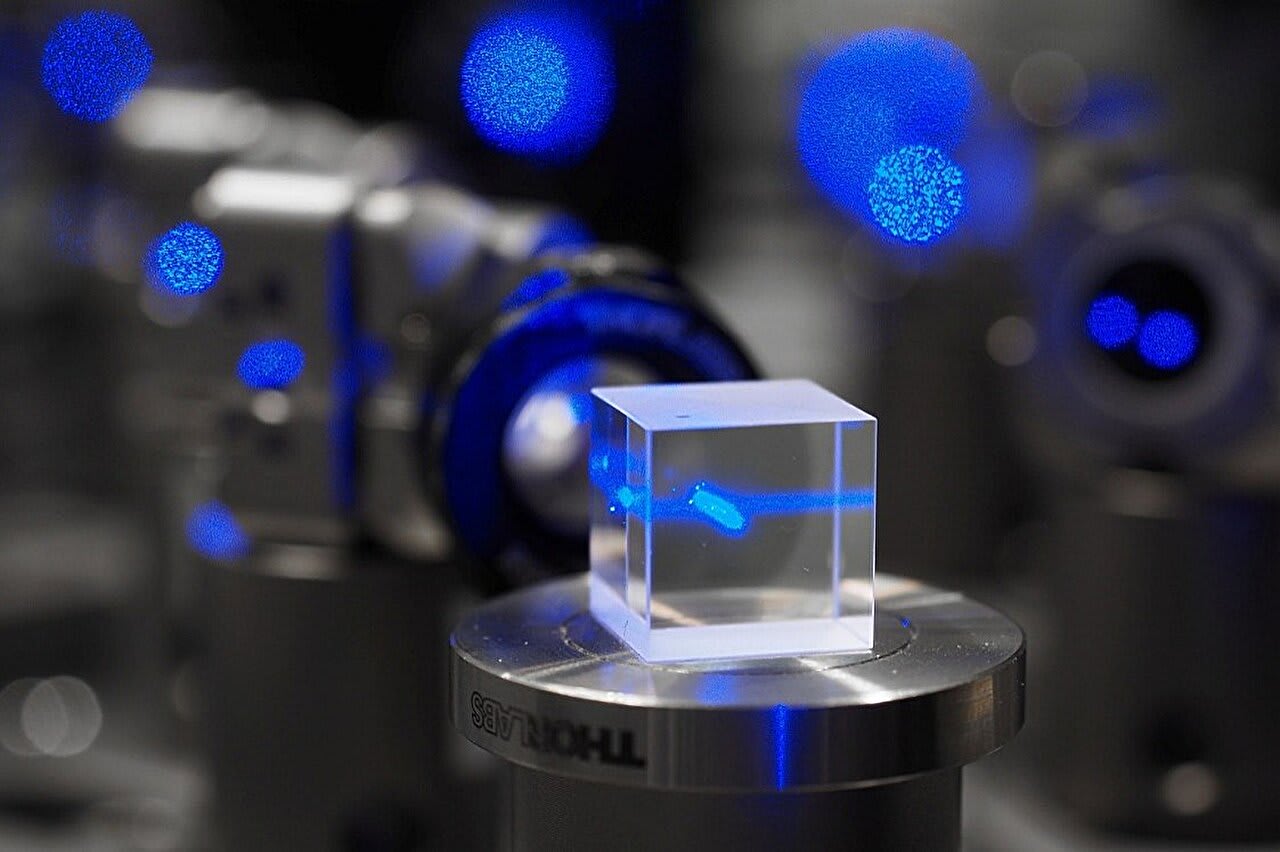
Researchers at Imperial College London have demonstrated for the first time that a prototype quantum sensor can cancel out overwhelming laser noise by comparing two atom interferometers, recovering faint signals that would otherwise be lost. The advance, published in Nature on June 17, validates a technique that underpins plans for next-generation detectors capable of searching for gravitational waves from the early universe and exotic forms of dark matter.imperial
The experiment, conducted in Imperial’s Ultracold Strontium Laboratory, used two separated clouds of ultracold strontium-87 atoms interrogated by a single clock laser. The setup was designed to mimic conditions in much larger future detectors, where controlling noise is far more difficult.miragenews
To stress-test the approach, the team deliberately injected phase noise far exceeding what clock lasers naturally produce. Each interferometer individually became unusable, its signal completely buried. But when the two instruments were compared, correlations between them revealed a clear signal. The combined measurement reached the fundamental quantum limit, confirming that the differential technique works as theorists had predicted.imperial
The team then injected an oscillating signal resembling what a passing gravitational wave or dark matter field might produce. It was detected clearly, even though neither interferometer alone contained usable information.miragenews
“We’ve known for a long time that quantum sensors can help us understand the universe, but it’s only recently that it’s become possible to build them with the resolution needed,” said Dr. Charles Baynham, co-lead of the laboratory.miragenews
The work is part of the Atom Interferometer Observatory and Network (AION) collaboration, a UK-wide effort led by Imperial that includes the Universities of Birmingham, Cambridge, Liverpool, King’s College London, and Oxford, along with the STFC Rutherford Appleton Laboratory. AION’s staged plan envisions scaling from a 10-meter prototype at Oxford to 100-meter and eventually kilometer-scale detectors.ic
The collaboration also partners with the MAGIS experiment at Fermilab in the United States and has proposed the Atom Interferometry CERN Experiment (AICE), which would apply similar techniques over much longer baselines.miragenews
“Our current experiment is just a prototype, but scaling it to a full-scale facility at laboratories such as CERN or Fermilab will allow us to tackle some of the deepest mysteries in physics, including the nature of dark matter,” said Dr. Richard Hobson, the laboratory’s other co-lead.miragenews