







Newsletter Subscribe
Enter your email address below and subscribe to our newsletter

Enter your email address below and subscribe to our newsletter
All voices matter
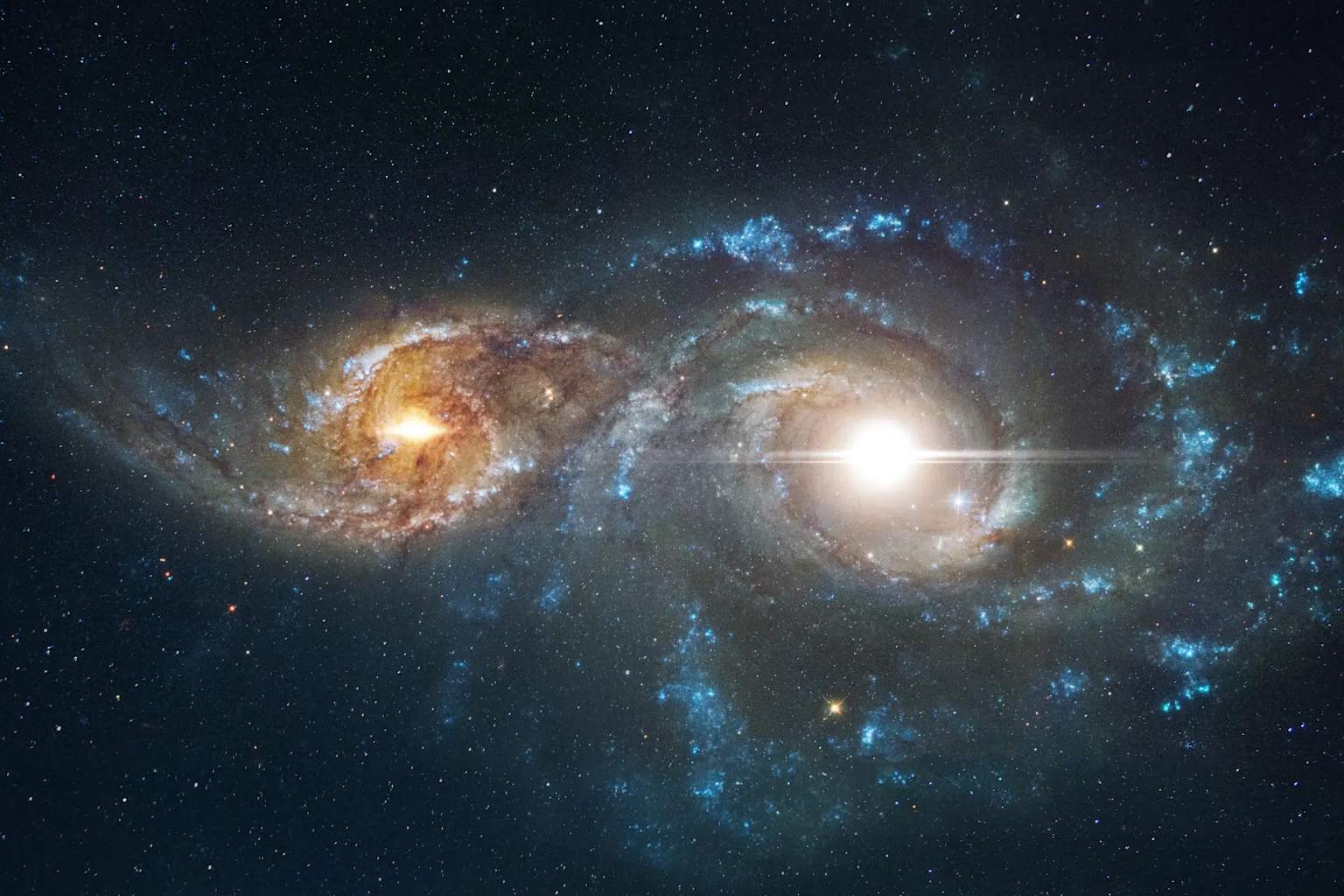
A team of astronomers has identified two ghostlike galaxies in the Fornax Cluster that appear to contain almost no dark matter, marking only the second known case of such a twin pair and adding fresh tension to standard models of galaxy formation.
The galaxies, FCC 224 and FCC 240, sit on the outskirts of the Fornax Cluster roughly 60 million light-years from Earth. A study led by Maria Luísa Buzzo of Yale University, uploaded to the arXiv preprint server on May 22 and reported by Phys.org on June 9, used the MUSE instrument on the Very Large Telescope to measure the galaxies’ internal motions.phys
Both galaxies exhibit extremely low velocity dispersions — their stars and globular clusters move so sluggishly that the gravitational pull can be explained by visible matter alone, with no need for a dark matter halo. Their dynamical masses within the half-light radius match their stellar masses, falling far below values expected for typical dwarf galaxies.gadgets360
Both also host unusually bright globular clusters with a top-heavy luminosity function, closely matching the traits of NGC 1052-DF2 and NGC 1052-DF4, the only previously confirmed pair of dark-matter-deficient galaxies.phys
The research investigates the “bullet-dwarf” hypothesis, which proposes that when two gas-rich dwarf galaxies collide at high speed, their dark matter halos pass through one another while ordinary matter physically collides, separating stars from dark matter and triggering an intense burst of star formation.phys
Supporting this scenario, FCC 224 and FCC 240 are nearly the same age — around 10 billion years old — and their globular clusters share identical age and metallicity with their host galaxies’ diffuse stellar bodies, suggesting everything formed together in a single violent episode.phys
However, one difference stands out. While DF2 and DF4 are separated by about 240 kiloparsecs with an extended trail of debris stretching over two megaparsecs, FCC 224 and FCC 240 sit only 75 kiloparsecs apart and are drifting toward each other at just 16 kilometers per second, forming what appears to be a compact, gravitationally bound pair.phys
The discovery of FCC 224 as a dark-matter-deficient galaxy outside the NGC 1052 group was first confirmed in 2025 using W.M. Keck Observatory. The new study extends that work by showing its companion FCC 240 shares the same peculiar properties.keckobservatory
“Taken together, these results suggest that FCC 224 and FCC 240 may have formed in a high-velocity collision similar to the event proposed for DF2 and DF4,” the researchers conclude. If confirmed, the finding would indicate that the process creating dark-matter-free galaxies is not a unique local oddity but a broader phenomenon — one that standard cosmological simulations have yet to reproduce.phys