







Newsletter Subscribe
Enter your email address below and subscribe to our newsletter

Enter your email address below and subscribe to our newsletter
All voices matter
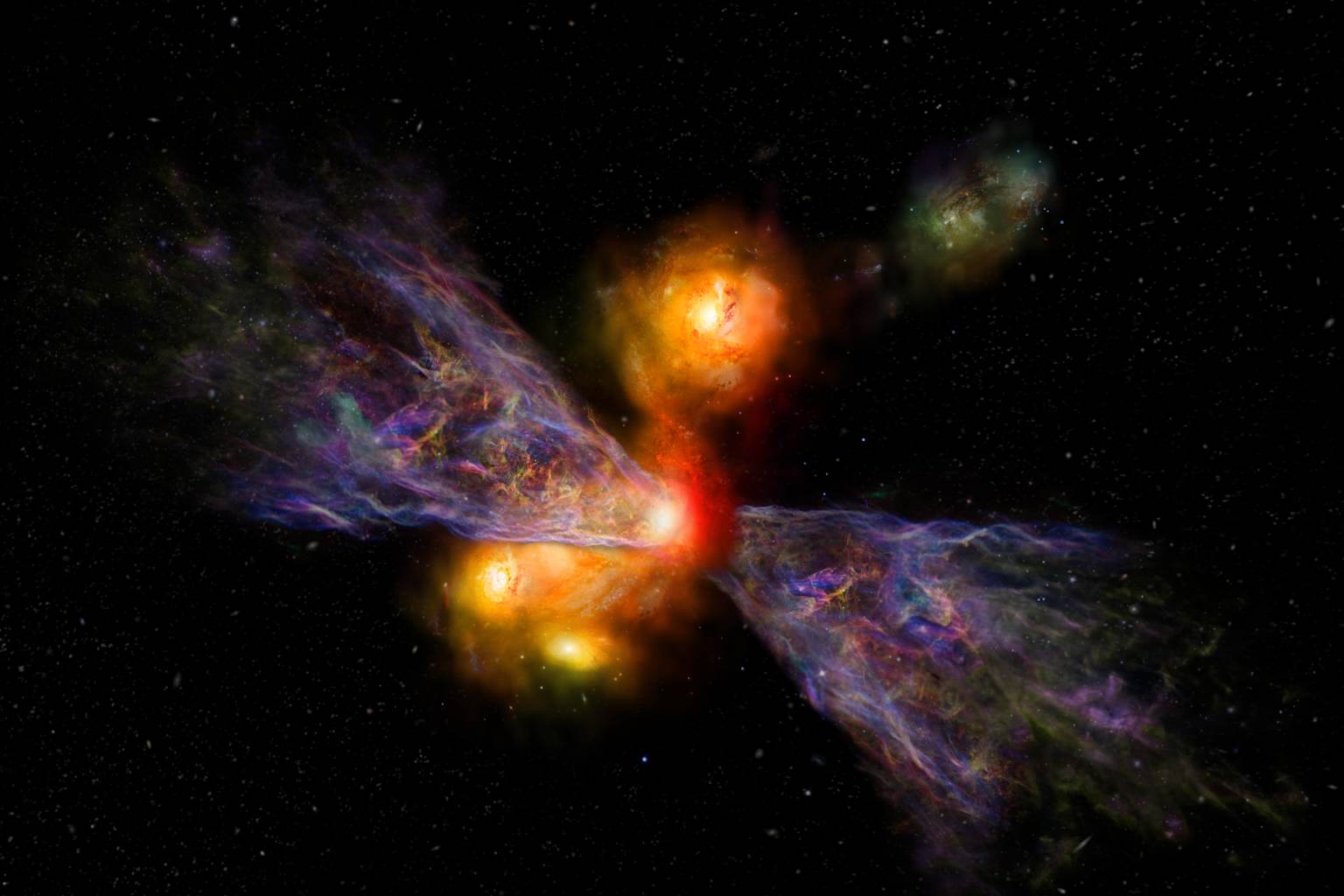
Astronomers have caught a galaxy in the act of blowing itself to death, observing a massive plume of cold gas being ejected from a young galaxy system seen just 1.1 billion years after the Big Bang. The discovery, published on Tuesday in Monthly Notices of the Royal Astronomical Society: Letters, offers a straightforward explanation for one of modern astrophysics’ most persistent puzzles: why so many massive galaxies in the early universe appear to have abruptly stopped forming stars.eurekalert
The galaxy system, known as CRISTAL-02, was observed using both the James Webb Space Telescope and the Atacama Large Millimeter/submillimeter Array (ALMA). Rather than a single settled galaxy, CRISTAL-02 is a collection of star-forming clumps in the final stages of a cosmic collision, forming stars at roughly 260 solar masses per year — about three times faster than expected for a galaxy of its mass at that epoch.astronomynow
But the same violence fueling its growth is also sealing its fate. The observations reveal a plume of cold gas extending around 7,000 light-years from the galaxy, moving outward at roughly 640 kilometres per second. The outflow is removing gas at about 520 solar masses per year — twice the rate at which new stars are being born.astronomynow
“The galaxy has a powerful wind that is ejecting material twice as fast as the galaxy forms stars,” said lead author Dr. Rebecca Davies of Swinburne University of Technology in Melbourne. “If this rapid blowout continues, the galaxy could be dead in less than 50 million years.”ras
Unlike previously observed galaxy-killing outflows driven by supermassive black holes, the CRISTAL-02 wind appears to be powered by supernovae — the explosive deaths of short-lived massive stars formed during the merger-triggered starburst. The team found no evidence of a currently active black hole driving the outflow, though they cannot rule out an earlier burst of such activity that has since faded.ras
The researchers combined ALMA’s view of cold material with JWST’s Near Infrared Spectrograph observations of warmer ionized gas, revealing a multiphase wind blasting outward in a two-coned shape above and below the galactic disc.astronomynow
The finding may extend well beyond a single galaxy. Davies noted that nearly half of massive galaxies at this epoch are undergoing major mergers, suggesting the mechanism could be common. “CRISTAL-02 offers a natural solution to the mystery of why these massive galaxies live fast and die young,” she said.ras
The study provides a physics-based alternative to more exotic proposals — such as the idea that dark energy behaved differently in the early universe — that have been invoked to explain the surprising abundance of dormant early galaxies revealed by JWST since 2022.astronomynow