






Newsletter Subscribe
Enter your email address below and subscribe to our newsletter

Enter your email address below and subscribe to our newsletter
All voices matter
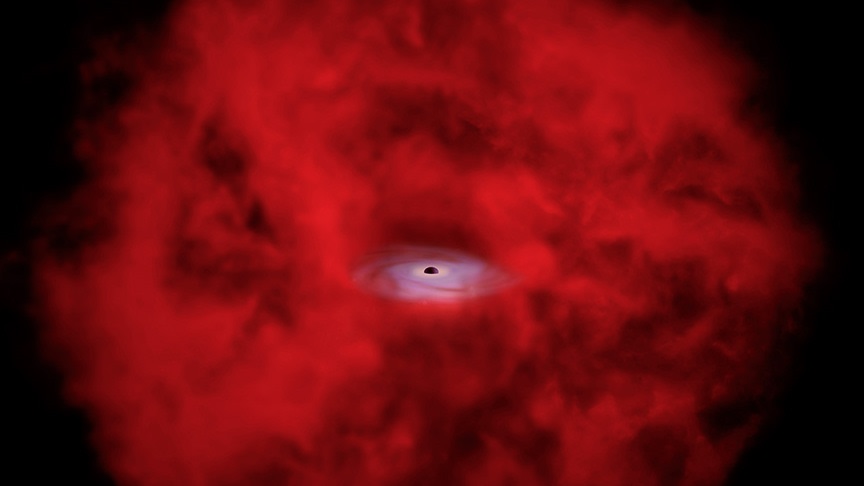
NASA’s James Webb Space Telescope has delivered the strongest evidence to date for the existence of so-called “black hole stars,” a theoretical class of cosmic object in which a rapidly growing supermassive black hole is shrouded in a dense cocoon of hot gas, according to findings published by the space agency on Tuesday.nasa
A team led by astronomer Vasily Kokorev at the University of Texas at Austin analyzed the deepest spectrum ever captured of a “little red dot” — one of hundreds of mysterious compact, reddish objects Webb has detected across the early universe. The object in question, GLIMPSE-17775, revealed more than 40 spectral lines across hydrogen, oxygen, and helium, all of which support the interpretation that this dot is a supermassive black hole enveloped in a dense cocoon of partially ionized gas.nasa
The spectral data did not match a simple rotating gas cloud model. Instead, the best-fit model includes a broadening effect known as electron scattering — a telltale sign that a layered gas cocoon is enshrouding the source and reprocessing the light emitted from near the black hole. Scientists refer to this configuration as the BH* (black hole star) scenario.nasa
Little red dots have puzzled astronomers since Webb began observations four years ago. Researchers have debated whether they are powered by growing black holes, dying massive stars, or some hybrid phenomenon. The new analysis of GLIMPSE-17775 offers the most detailed evidence yet in favor of the accreting black hole interpretation, with multiple independent indicators all pointing in the same direction.nasa
In a separate discovery published in the journal Science, an international team used Webb to measure the mass of the most distant dormant supermassive black hole ever detected. Located at the heart of galaxy MRG-M0138, more than 10 billion light-years away, the black hole weighs roughly six billion times the mass of the Sun. It is 15 times farther away than the previous record for a dormant black hole mass measurement.space
Because the black hole is no longer actively consuming material, the team inferred its presence by tracking the motion of stars orbiting around it using Webb’s NIRSpec instrument. The galaxy is seen as it existed when the universe was only about three billion years old — roughly a quarter of its current age.ucl
Together, the two findings underscore Webb’s growing role in resolving longstanding mysteries about how supermassive black holes formed and evolved in the early universe.