Newsletter Subscribe
Enter your email address below and subscribe to our newsletter

Enter your email address below and subscribe to our newsletter
All voices matter
Road-building in the Amazon rainforest has long been synonymous with environmental destruction, but archaeological surveys required before paving begins are now yielding a trove of artifacts that illuminate thousands of years of Indigenous life in the region. The latest discoveries, reported by the Associated Press, have emerged along the BR-156 highway in Brazil’s northern state of Amapá, where excavations at nine sites have turned up pottery vases believed to be funerary urns and small artifacts resembling human faces.wtop
The finds reinforce a growing scientific consensus: the Amazon was not an uninhabited wilderness before European colonization but a landscape shaped by interconnected societies over millennia.
Archaeologist Manoel Fabiano da Silva Santos, working for Brazil’s National Department of Transport Infrastructure, described the Amazon soil as a historic timeline. In the upper layers, his team recovered Portuguese porcelain and nails tied to European occupation. “Digging deeper, we uncovered pottery and ceramics associated with earlier Indigenous presence, marking the site’s transition before and after the arrival of colonizers,” Santos said.bastillepost
The pottery found along BR-156 displayed multiple styles and techniques reflecting influences from communities as far-flung as Brazil’s Pará state and the Caribbean. The artifacts will join Amapá’s state collection of roughly 530,000 pieces, the oldest of which dates back approximately 6,140 years, according to Lúcio Flávio Costa Leite, who manages the Archaeological Research Center at Amapá’s Institute for Scientific and Technological Research.wtop
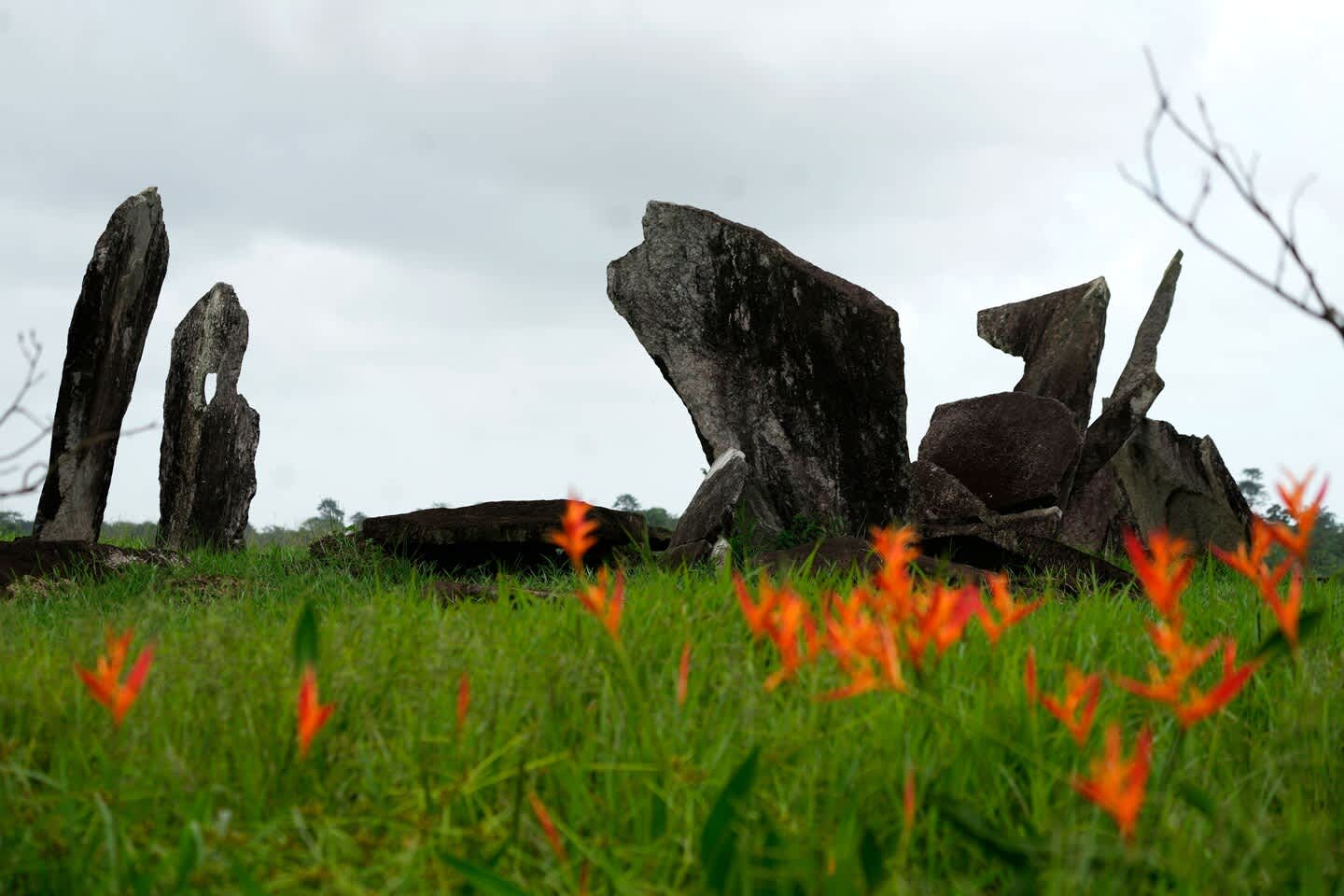
Among Amapá’s most striking archaeological sites is a 1,000-year-old stone monument in the city of Calçoene, composed of 127 carved monoliths arranged in a circle roughly 30 meters wide. Dubbed by some the “Stonehenge of the Amazon,” the stones were positioned to mark the exact point of sunrise during the Northern Hemisphere’s winter solstice, according to archaeologist Mariana Petry Cabral of the Federal University of Minas Gerais.yahoo
Meanwhile, satellite scans conducted through the Amazon Revealed project, led since 2023 by University of São Paulo archaeologist Eduardo Neves, have identified networks of ancient roads connecting clusters of settlements across the forest, most visibly in southern Amazonas state and Acre. A recent study published in the journal Latin American Antiquity confirmed 350 kilometers of ancient roads comprising more than 950 individual segments in southwestern Amazonia, with radiocarbon dating placing the earliest road-building between 763 and 399 BC.wtop
“When people think of an Indigenous tribe, they often imagine a small village isolated in the middle of the forest. But evidence shows a high degree of interconnectivity linking different settlements,” Neves said. Cabral added that “Amapá is a key piece that helps us see how dynamic and active these populations were, and how they maintained networks of exchange that have been in place for millennia”.wtop