




Newsletter Subscribe
Enter your email address below and subscribe to our newsletter

Enter your email address below and subscribe to our newsletter
All voices matter
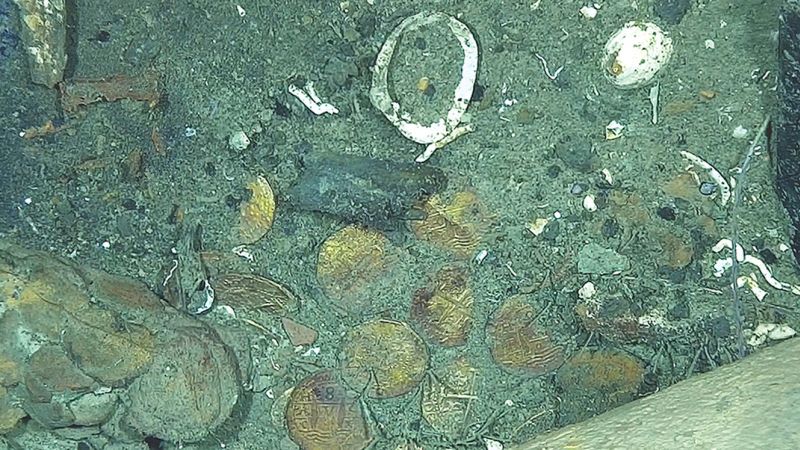
Colombian scientists have retrieved the first objects from the legendary Spanish galleon San José, bringing to the surface a cannon, three coins, and a porcelain cup from the Caribbean seabed where the vessel has rested for more than three centuries. The artifacts, announced Thursday by authorities, mark the initial recovery from a shipwreck believed to hold one of the world’s most valuable underwater treasures.newsmax
The recovery is part of a scientific investigation authorized by President Gustavo Petro’s government last year to study the wreckage and determine the causes of its sinking. Colombia’s culture ministry said the objects will undergo conservation at a laboratory dedicated to the expedition. The wreck lies nearly 600 meters deep in waters off Cartagena, its exact location kept as a state secret.abcnews
The San José, a 62-gun, three-masted galleon, sank on June 8, 1708, during a battle with British naval forces led by Admiral Charles Wager. The vessel exploded after being attacked by the HMS Expedition, taking approximately 600 crew members to the ocean floor, with only 11 survivors. The ship was carrying gold and silver coins, emeralds, and other precious cargo from Spanish-controlled colonies, believed to total 11 million coins and potentially worth billions of dollars.abcnews
Colombian researchers located the galleon in 2015 with assistance from the Woods Hole Oceanographic Institution, using an autonomous underwater vehicle called REMUS 6000. The prevailing theory attributes the sinking to an explosion during the English ambush, though Colombia’s government has suggested hull damage may have contributed.newsmax
The shipwreck has sparked complex legal battles involving multiple parties. Sea Search Armada, a U.S. salvage company, claims it discovered the wreck in 1982 and is seeking $10 billion, equivalent to what it estimates as 50 percent of the treasure’s value. Colombia disputes this claim, stating the coordinates provided by the company were inaccurate by up to 10 kilometers.newsmax
Spain has asserted ownership rights as the vessel belonged to its navy, while indigenous Qhara Qhara communities in Bolivia argue the treasure should belong to them, as their ancestors were forced to mine the precious metals under Spanish colonial rule. The Permanent Court of Arbitration in The Hague is currently reviewing the dispute, with a substantive hearing held in November 2025.nzdrc
According to Alhena Caicedo, director of the Colombian Institute of Anthropology and History, sediment samples collected around the ship will be analyzed to “better understand the causes of the shipwreck”.yahoo