







Newsletter Subscribe
Enter your email address below and subscribe to our newsletter

Enter your email address below and subscribe to our newsletter
All voices matter
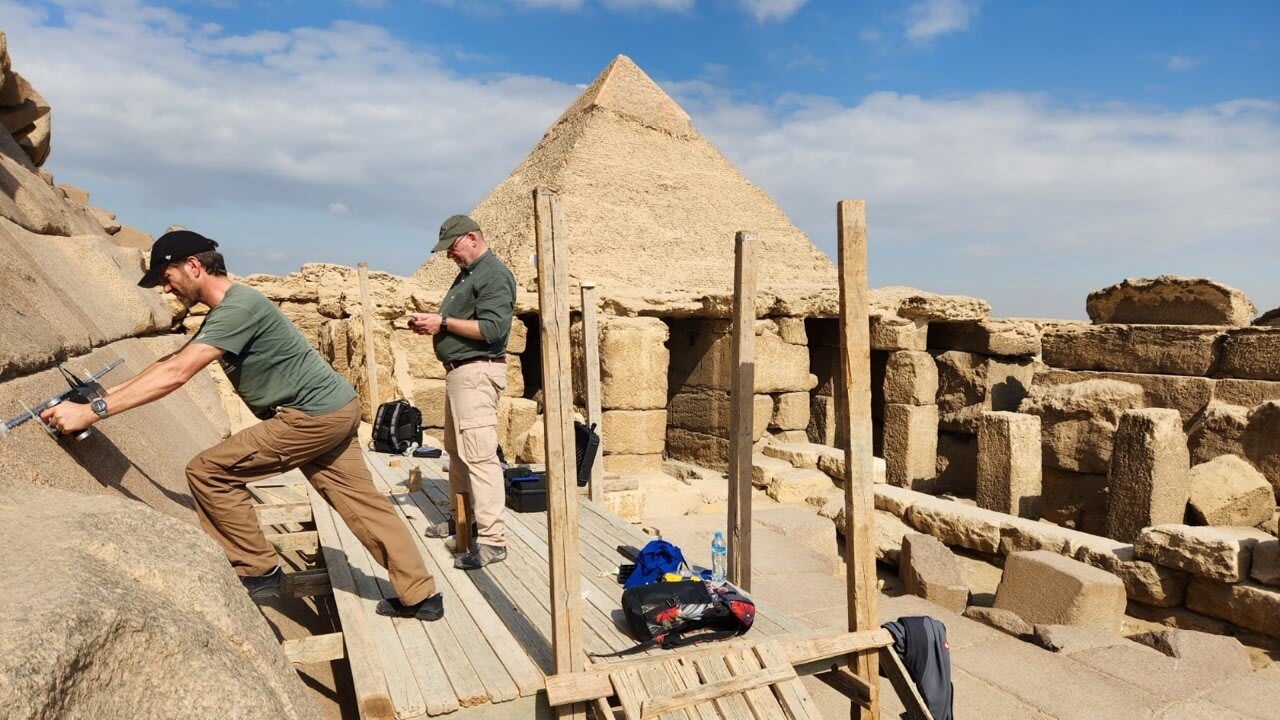
Researchers have discovered two hidden air-filled voids behind the eastern facade of the Menkaure Pyramid at Giza, providing the first evidence supporting a long-standing hypothesis about a previously unknown entrance to the ancient structure. The findings, announced this week by an international team from Cairo University and the Technical University of Munich, mark another success for the ScanPyramids project, which has been systematically investigating Egypt’s iconic pyramids using non-invasive scanning technology.phys
The team employed ground-penetrating radar, ultrasound, and electrical resistivity tomography to detect the anomalies, which measure approximately 1 meter by 1.5 meters and 0.9 meters by 0.7 meters, located 1.4 meters and 1.13 meters beneath the outer surface. This marks the first time structural anomalies have been identified behind the distinctive polished granite blocks on the pyramid’s eastern face, an area about 4 meters high and 6 meters wide that has puzzled researchers for years.miragenews
The refined finish of these eastern stones is otherwise found only at the pyramid’s known northern entrance, leading researcher Stijn van den Hoven to hypothesize a possible second entrance in 2019. “Following the significant validation of a hidden corridor in the Pyramid of Cheops in 2023, ScanPyramids has once again succeeded in making an important finding in Giza,” said Christian Grosse, professor of non-destructive testing at TUM. “The testing methodology we developed allows very precise conclusions to be drawn about the nature of the pyramid’s interior without damaging the valuable structure. The hypothesis of another entrance is very plausible, and our results take us a big step closer to confirming it.”phys
The precise detection was made possible through an Image Fusion methodology that combined data from all three scanning techniques into composite images. The research, published in the journal NDT & E International, was conducted in collaboration with the Egyptian Supreme Council of Antiquities and the Ministry of Tourism and Antiquities.miragenews
The Menkaure Pyramid, standing over 60 meters tall, is the smallest of Giza’s three main pyramids and was built as a tomb for Fourth Dynasty King Menkaure around the 26th century BC. The ScanPyramids project previously made headlines in 2023 when it confirmed a hidden corridor in the neighboring Pyramid of Khufu using similar non-destructive techniques.phys