







Newsletter Subscribe
Enter your email address below and subscribe to our newsletter

Enter your email address below and subscribe to our newsletter
All voices matter
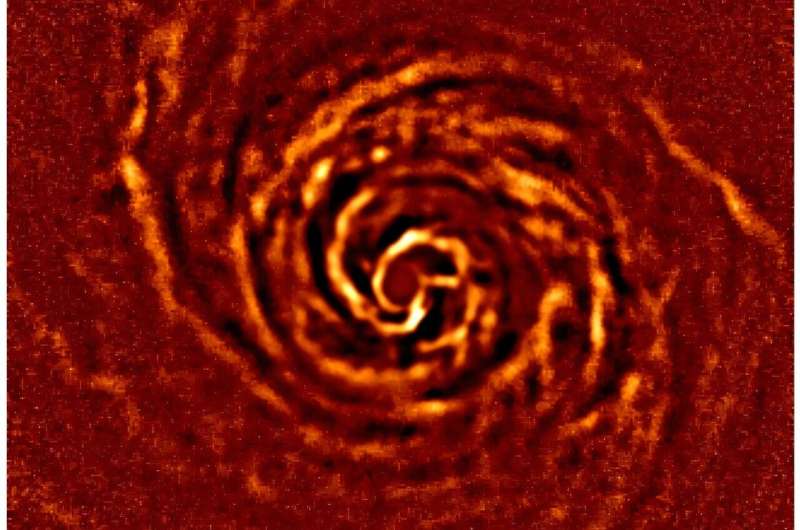
For the first time, astronomers have directly watched a protoplanetary disk spin, capturing images over four years that show the swirling nursery of gas and dust where planets are being born around the young star AB Aurigae.
The study, published on June 1, 2026, in the journal Astronomy & Astrophysics, was led by scientists from France’s CNRS and the University of Bordeaux. Using the SPHERE instrument on ESO’s Very Large Telescope in Chile, the team tracked dust grain emissions within the disk surrounding AB Aurigae, a star located about 520 light-years from Earth in the constellation Auriga.cnrs
By blocking the glare of the central star, SPHERE revealed the disk in detail across three sets of observations collected over a four-year period. The resulting sequence of images shows the disk rotating around the star — the first time such motion has been directly mapped through dust emissions rather than inferred from gas velocities.eso
While the disk largely rotates as predicted by physics, certain regions close to the star show unexpected departures from normal behavior. The researchers identified a bright structure characteristic of accretion zones — areas where gas and dust accumulate and fall onto an object in the process of forming. According to the CNRS, this phenomenon is “closely linked to the formation of gas giant planets”.cnrs
The images also reveal rapidly rotating faint shadows cast onto the disk’s surface by structures that cannot be seen directly. These could be protoplanets or opaque clumps of dust orbiting near the star.eso
AB Aurigae has long been a focus of planet-formation research. In 2020, the same SPHERE instrument revealed spiral structures and a “twist” in the disk marking a likely planet-forming site. More recently, in September 2025, a separate team used ESO’s Very Large Telescope to detect hydrogen emissions from the protoplanet AB Aurigae b, providing direct evidence of material falling onto a growing planet still shrouded in dust.earthsky
The new findings, the researchers noted, are “more complex than those predicted by theoretical models,” underscoring the need for continued observation to directly detect the properties of the protoplanets or dense clumps responsible for the disk’s unusual dynamics.cnrs