Newsletter Subscribe
Enter your email address below and subscribe to our newsletter

Enter your email address below and subscribe to our newsletter
All voices matter
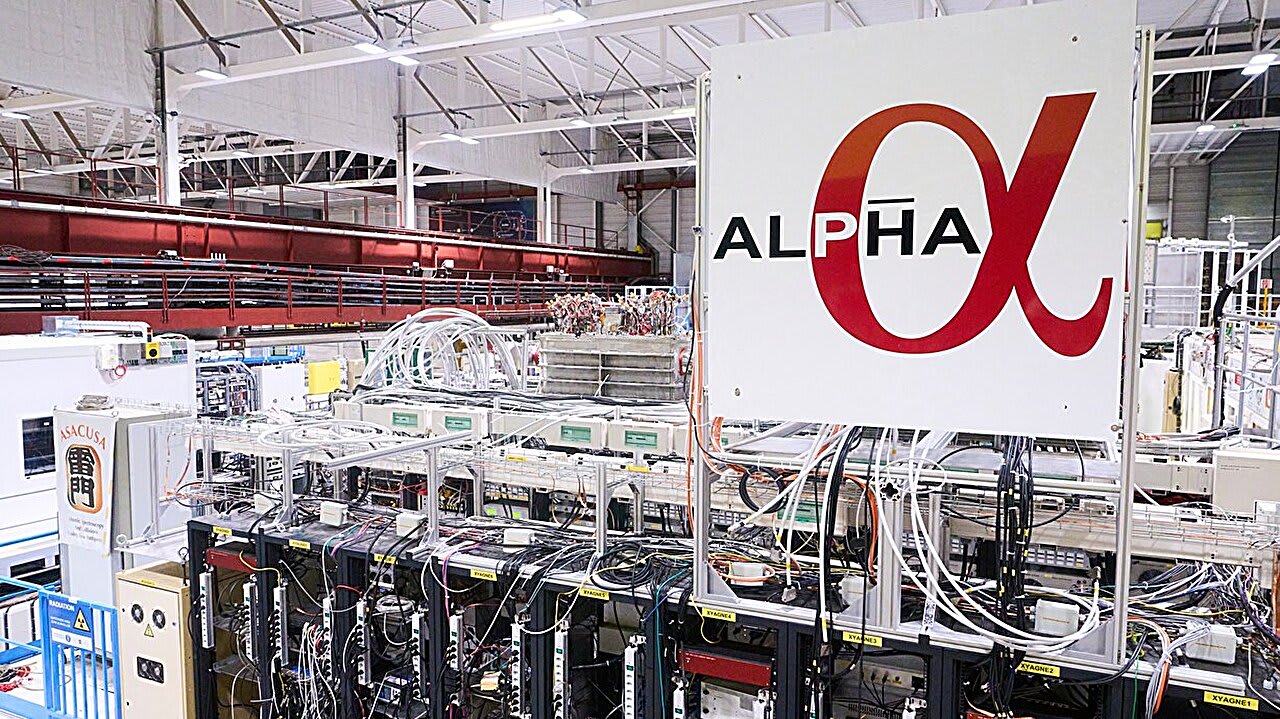
Researchers at CERN’s ALPHA experiment have measured a fundamental property of antihydrogen with a precision of 4 parts per million, improving on their previous result by two orders of magnitude. The finding, published on May 27 in Nature, brings scientists closer to understanding whether antimatter obeys the same physical laws as ordinary matter.nature
The ALPHA Collaboration measured the ground-state hyperfine splitting of antihydrogen — the tiny division of the atom’s lowest energy level caused by the magnetic interaction between an antiproton and a positron. In ordinary hydrogen, this splitting gives rise to the 21-centimeter spectral line used by radio astronomers and even researchers searching for extraterrestrial intelligence.home
“When the Antimatter Factory was conceived back in the 1990s, the hyperfine splitting of antihydrogen was one of the key targets for measurement that would justify constructing the facility,” said Jeffrey Hangst, spokesperson for the ALPHA experiment.home
The hydrogen version of this measurement has been pinned down to less than one part in a trillion, making it one of the most precisely known quantities in physics. Antihydrogen, however, presents an extreme challenge: the atoms annihilate on contact with normal matter, so they must be carefully produced and suspended in magnetic traps.home
In 2017, the ALPHA team first observed the antihydrogen hyperfine splitting with a precision of about 400 parts per million. The new result narrows that uncertainty by a factor of 100, reaching 4 parts per million — precise enough to begin probing the internal structure of the antiproton at the heart of antihydrogen.physicsworld
The leap in precision was made possible in part by a technique reported last year in Nature Communications, in which the ALPHA team used laser-cooled beryllium ions to sympathetically cool positrons to around 10 kelvin. The colder positrons dramatically boosted the efficiency of antihydrogen creation and trapping, allowing the collaboration to accumulate more than 15,000 antihydrogen atoms in under seven hours — a more than twentyfold improvement over the previous record of 2,000 atoms in 24 hours.home
“These numbers would have been considered science fiction 10 years ago,” Hangst said when the production technique was announced.home
At the current level of precision, the antihydrogen measurement is consistent with the value for hydrogen, upholding the charge-parity-time (CPT) symmetry predicted by the Standard Model of particle physics. The result also opens the door to stringent new tests of quantum electrodynamics, the theory describing interactions between charged particles and light.home
Hangst noted that a separate collaboration at CERN’s Antimatter Factory, the ASACUSA experiment, is also working to study the same transition using a beam-based technique that could eventually achieve even higher precision.home