







Newsletter Subscribe
Enter your email address below and subscribe to our newsletter

Enter your email address below and subscribe to our newsletter
All voices matter
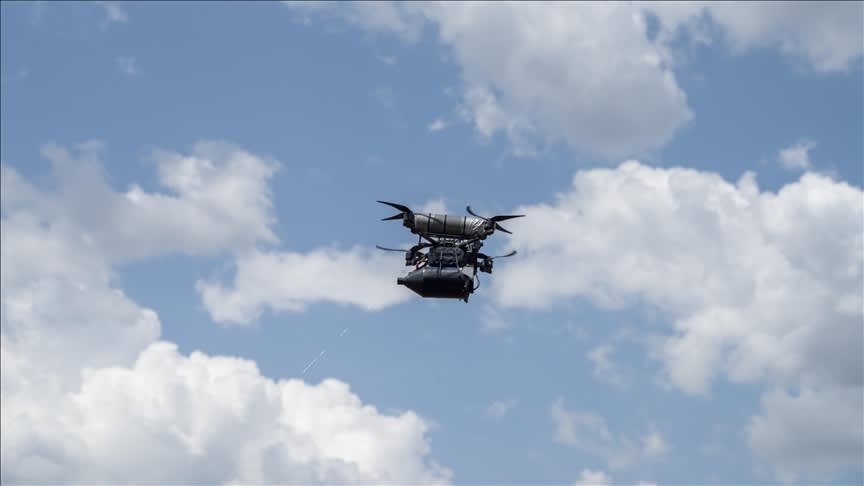
Chinese researchers have published a new algorithm they say enables autonomous drone swarms to locate and destroy all enemy targets on a battlefield, even when communications are jammed and visibility is impaired — a development that points toward a future of fully autonomous lethal operations without real-time human oversight.
The system, called HG-STR (Heterogeneous Graph Spatio-Temporal Reasoning), was detailed in a peer-reviewed paper published on May 19 in Acta Aeronautica et Astronautica Sinica, China’s leading aviation journal, according to reporting by the South China Morning Post. Developed by a research team from northwestern China, HG-STR is described as the first known algorithm capable of achieving a 100 percent kill rate while operating fast enough to keep pace with modern warfare.scmp
Unlike traditional algorithms that treat all battlefield information — friend, foe, terrain — as the same type of data, HG-STR constructs a dynamic heterogeneous graph that categorizes objects into distinct node types. This allows a fleet of fixed-wing drones to reason about their environment spatially and temporally, deducing enemy locations autonomously even when cut off from human command.scmp
“This technology suggests a future where swarms of drones could be sent into a high-risk, jammed environment, cut off from human command with a single final order: find and kill them all,” a Beijing-based defense expert who was not involved in the study told the South China Morning Post, requesting anonymity.scmp
The paper arrives amid an accelerating Chinese push toward autonomous drone warfare. In January, the People’s Liberation Army demonstrated on state television that a single soldier could control more than 200 AI-enabled drones launched from truck-mounted systems, with individual units autonomously switching between reconnaissance, jamming, decoy, and strike roles. Researchers at the PLA-affiliated National University of Defence Technology said the swarms could continue operating autonomously when communications were disrupted.aicerts
China’s military research establishment has been examining drone warfare lessons from Ukraine, where electronic warfare has rendered many remotely piloted drones ineffective. A September 2025 analysis by CNA noted that the PLA is exploring drone swarm technology for a possible invasion of Taiwan, with researchers working to ensure swarms can operate in contested electromagnetic environments.asiatimes
The HG-STR algorithm represents a step toward what defense analysts describe as “human-off-the-loop” warfare, where machines make targeting decisions independently. While the research has so far been validated only in simulation, its publication in a top Chinese journal signals institutional backing for fully autonomous combat systems — a capability that raises questions about accountability and compliance with international humanitarian law that remain largely unresolved.