








Newsletter Subscribe
Enter your email address below and subscribe to our newsletter
Enter your email address below and subscribe to our newsletter

All voices matter
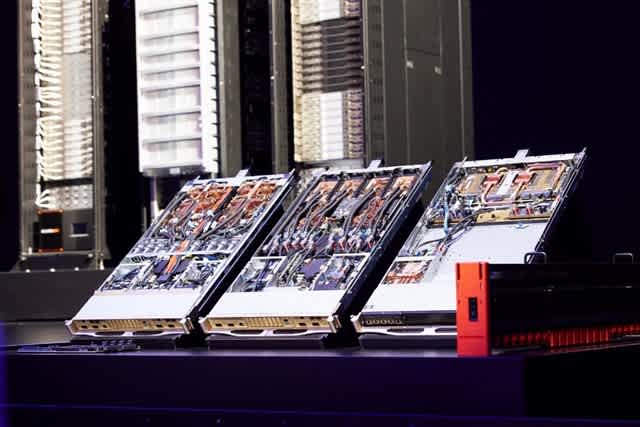
Dell Technologies unveiled the PowerEdge XE8812 server on Monday at the ISC High Performance 2026 conference in Hamburg, Germany, marking the first major hardware platform built on Nvidia’s next-generation Vera Rubin NVL4 architecture.investing
The fanless, direct liquid-cooled server supports up to 144 GPUs per rack and delivers more than 7 exaflops of AI performance alongside 5 petaflops of native double-precision (FP64) computing — performance the company says rivals systems on the TOP500 list of the world’s most powerful supercomputers.investing
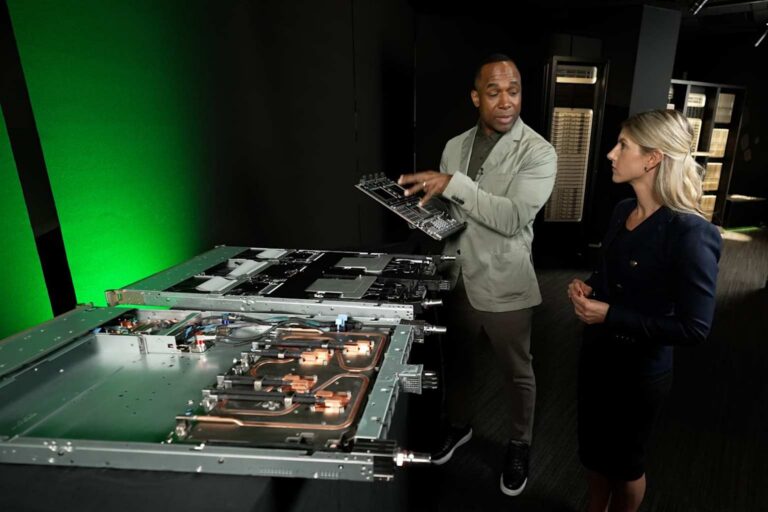
Compared to its predecessor based on the Nvidia GB200 NVL4, the XE8812 expands CPU core count from 144 to 176 and offers 50 percent more memory per socket along with increased GPU memory. The system is deployed in an ORv3-style rack supporting more than 300 kilowatts of power with 100 percent direct liquid cooling for both CPUs and GPUs.investing
The announcement is part of Nvidia’s wider push to bring its Vera Rubin platform to market through global system manufacturers. Bull, Dell, GIGABYTE, HPE, and Super Micro Computer all announced plans to offer Vera Rubin NVL4-based systems in direct liquid-cooled configurations. Nvidia indicated that these systems are expected to be available from manufacturers by the fourth quarter of 2026, while Dell’s PowerEdge XE8812 specifically will be available worldwide in early 2027.investing
Supermicro separately announced a Data Center Building Block Solutions blueprint for the Vera Rubin NVL4 platform at ISC, featuring up to 1,152 Nvidia Rubin GPUs and 576 Nvidia Vera CPUs in liquid-cooled racks.investing
A Dell Technologies system powered by the Vera Rubin platform will also serve as the backbone of “Doudna,” the next flagship supercomputer at the Department of Energy’s National Energy Research Scientific Computing Center at Lawrence Berkeley National Laboratory. Announced in May 2025 by Energy Secretary Chris Wright, the system is named after Nobel Prize-winning biochemist Jennifer Doudna and will support approximately 11,000 researchers working in fields including high-energy physics, molecular dynamics, and AI training.nextgov