









Newsletter Subscribe
Enter your email address below and subscribe to our newsletter
Enter your email address below and subscribe to our newsletter

All voices matter
Nvidia used London Climate Action Week on Monday to declare that the data center industry’s mounting water crisis has a solution: cooling AI chips with liquid warm enough to fill a hot tub.
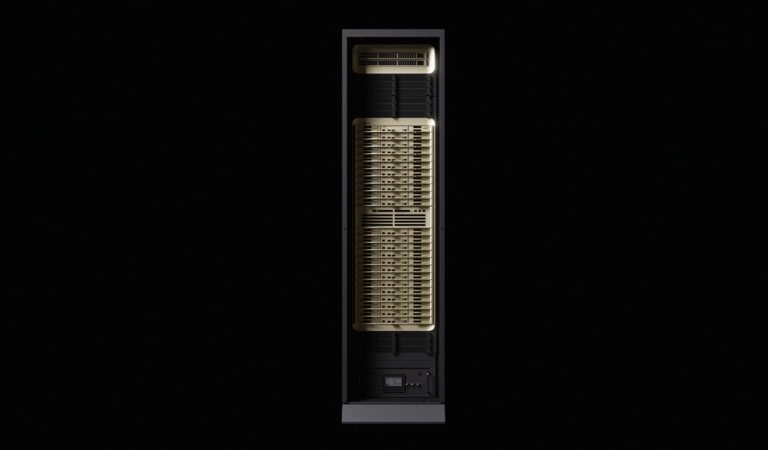
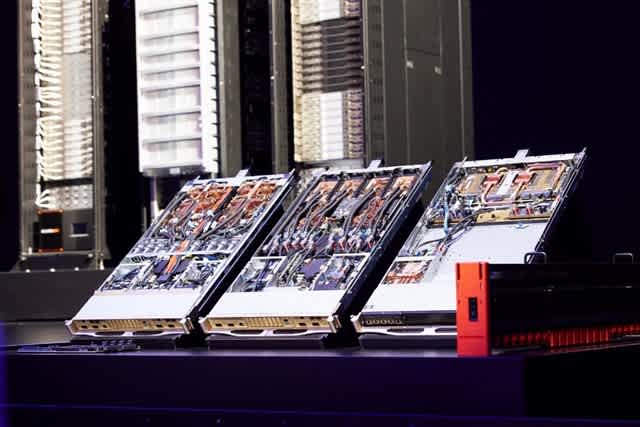
The company’s Rubin platform — its next-generation AI server architecture set to begin mass production this autumn — is the first to achieve 100 percent liquid cooling across every chip and networking component, eliminating fans entirely. A closed-loop system circulates a mixture of 75 percent water and 25 percent propylene glycol through cold plates mounted directly on processors, entering at 45 degrees Celsius (113 degrees Fahrenheit) and exiting at roughly 55 degrees after absorbing heat. Because the loop is sealed, no water evaporates into the atmosphere.telborg
The counterintuitive core of the design is that hotter coolant requires less energy to reject heat. Industry data cited by Nvidia shows that raising chiller plant temperatures by a single degree Celsius cuts cooling energy costs by roughly 4 percent. At 45 degrees, outdoor dry coolers — essentially large radiator coils — can handle the job in many climates without ever engaging a mechanical chiller.omegatechnologysolutionsgroupinc
Ali Heydari, Nvidia’s director of data center cooling and infrastructure, said the design achieves “near zero” water consumption for facilities using dry-cooler systems, with chillers needed only about 1 percent of annual operating hours in some locations. For a 50-megawatt hyperscale facility, Nvidia estimates the shift could save more than $4 million a year in combined energy and water costs.telborg
The concept was first previewed by CEO Jensen Huang at CES 2026 in January, when he told the audience: “No water chillers are necessary for data centers. We’re basically cooling this supercomputer with hot water”. Monday’s announcement formalized the approach within the Nvidia DSX AI factory reference design, which serves as a blueprint for cloud providers and data center operators building Rubin-based systems.futunn
Microsoft has been moving in a parallel direction. The company’s Fairwater data centers in Wisconsin and Atlanta already use closed-loop liquid cooling with zero water evaporation, and Steve Solomon, vice president of data center infrastructure engineering, has said the approach eliminates the need for fresh water supply once the system is filled during construction. Microsoft applied the technology to new facilities in Phoenix, Arizona, and Mt. Pleasant, Wisconsin, in 2024, with operations beginning this year.w
The announcements arrive against a backdrop of intensifying scrutiny. A report published June 3 by the United Nations University Institute for Water, Environment and Health projected that data centers could consume 9.3 trillion litres of water annually by 2030 — enough to meet the basic domestic needs of 1.3 billion people in Sub-Saharan Africa. Separately, Amazon disclosed earlier this month that its data centers used 0.12 litres of water per kilowatt-hour, which it described as seven times more efficient than the industry average, while reporting it is 75 percent of the way toward its goal of becoming water-positive by 2030.ndtv
Nvidia’s approach works best where ambient temperatures allow dry coolers to dissipate heat year-round. In hot, humid regions such as parts of Texas or Southeast Asia, the water-saving benefits may be more limited, and some mechanical cooling could still be required. The transition also demands a wholesale redesign of data center infrastructure — Nvidia has stated that every cloud provider building Rubin systems must complete a full shift to liquid cooling.valuethemarkets