Newsletter Subscribe
Enter your email address below and subscribe to our newsletter

Enter your email address below and subscribe to our newsletter
All voices matter
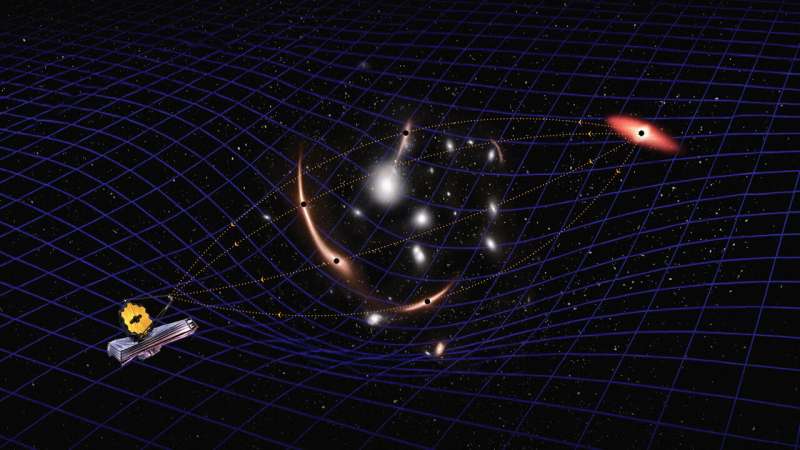
Astronomers have for the first time measured the mass of a dormant supermassive black hole in the distant universe, using the James Webb Space Telescope to track the motion of stars around an invisible cosmic giant lurking more than 10 billion light-years from Earth.
The black hole, located at the center of a galaxy called MRG-M0138, weighs roughly 6 billion times the mass of the Sun and is 15 times farther away than the previous record for a dormant black hole detected through stellar dynamics. The findings, led by Andrew Newman of Carnegie Science in Pasadena, California, were published Thursday in the journal Science.eurekalert
Unlike actively feeding black holes that announce themselves through luminous jets and radiation, dormant black holes emit no light and cannot be seen directly. The researchers instead relied on a technique called stellar dynamics — observing how fast stars move near the galactic center and comparing those speeds to stars farther away — to infer the black hole’s mass.bioengineer
The galaxy was observed at an epoch when the universe was only about 3 billion years old. Ordinarily, resolving individual stellar motions at such a distance would be impossible, but the team exploited gravitational lensing — a foreground galaxy cluster bending and magnifying the light from MRG-M0138 roughly 30-fold — to peer within the black hole’s sphere of influence.miragenews
“By combining JWST data with gravitational lensing, we could peer inside the black hole’s sphere of influence, where its gravity boosts the speeds of stars,” Newman said. “This is one of the best techniques we have to weigh a black hole, so we were excited to extend it to a much earlier period in cosmic history.”miragenews
Previously, the farthest galaxy studied with this stellar dynamics technique was only about 700 million light-years away. The leap to more than 10 billion light-years opens a new window into how black holes and their host galaxies co-evolved in the early cosmos.arxiv
MRG-M0138 itself is no longer forming stars, suggesting its black hole may have once powered a luminous quasar phase that expelled the gas needed for stellar birth. The finding confirms that the tight relationship between black hole mass and galaxy properties seen in the local universe was already in place when the cosmos was a fraction of its current age.miragenews
Richard Ellis, a co-author from University College London, said the result demonstrates the feasibility of weighing dormant black holes at cosmological distances. “We can now undertake a more complete census of how black holes develop over time and infer their role in shaping galaxy evolution,” he said.miragenews
The team expects future JWST observations and upcoming facilities such as the Giant Magellan Telescope will reveal many more dormant black holes from the early universe, offering deeper insight into how these silent giants shaped the galaxies around them.bioengineer