






Newsletter Subscribe
Enter your email address below and subscribe to our newsletter

Enter your email address below and subscribe to our newsletter
All voices matter
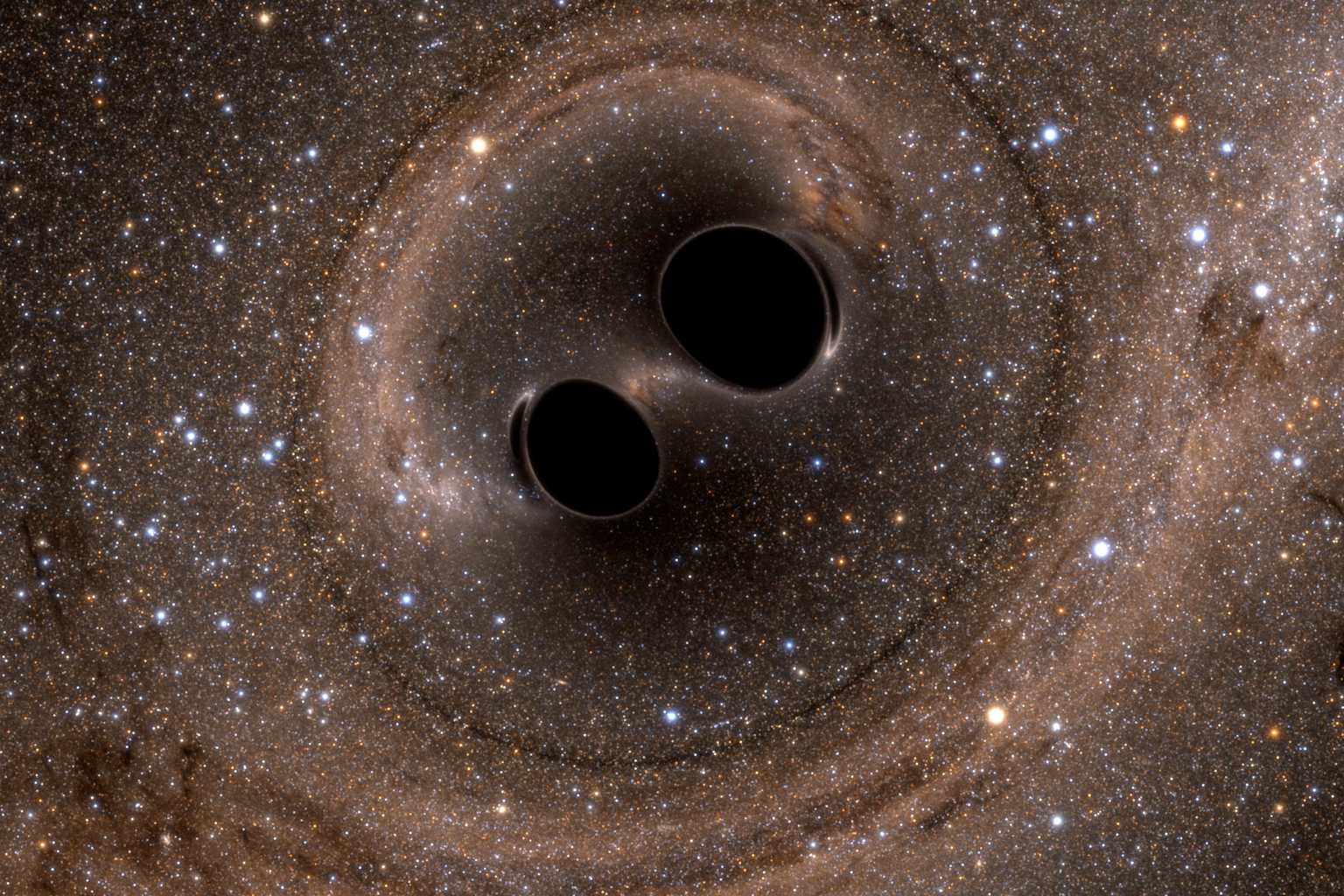
The LIGO-Virgo-KAGRA collaboration on Tuesday published GWTC-5, the largest catalog of gravitational wave events ever compiled, adding 161 newly detected signals and bringing the total number of confirmed detections since 2015 to 390. The release, accompanied by papers submitted to The Astrophysical Journal and Astrophysical Journal Letters, marks what researchers are calling the arrival of “precision gravitational-wave astronomy” — a decade after the first detection of ripples in spacetime.ego-gw
The new events, collected between April 2024 and the end of January 2025 during the second part of the collaboration’s fourth observing run, include several record-setting observations.mpg
The catalog’s standout entry is GW250114, a black hole merger detected on January 14, 2025, which produced the clearest gravitational wave signal ever recorded, with a signal-to-noise ratio of 76.9. Generated by two black holes of nearly equal mass — 32 and 34 times the mass of the Sun — colliding more than one billion light-years from Earth, the signal was clear enough to allow researchers to measure two vibrational tones of the resulting black hole and constrain a third, all consistent with Einstein’s general relativity.ego-gw
“If you measure two or more tones in the data, each of those is effectively giving you a different mass and spin measurement, according to general relativity,” said Cornell University physicist Keefe Mitman. “GW250114 was clear enough for the researchers to measure two tones and constrain a third. All agree with Einstein’s general relativity.”ego-gw
A separate event, GW240615, set the record for the most precise sky localization of any gravitational wave source, pinpointed within just 6 square degrees. That precision was made possible by triangulating data from both LIGO detectors and the Virgo detector in Italy, which rejoined observations in April 2024.mpg
Two mergers detected in October and November 2024 — GW241011 and GW241110 — provided evidence for the existence of “second-generation” black holes, objects formed not from collapsing stars but from previous black hole mergers in dense environments like stellar clusters. Researchers found that a population of black holes between 10 and 20 solar masses share rapid spins characteristic of such hierarchical formation, suggesting multiple pathways for creating merging black holes.gla
The expanded dataset also enabled the collaboration’s most precise gravitational-wave measurement of the Hubble constant to date: 71 kilometers per second per megaparsec, more than 25 percent more precise than estimates from the previous catalog. While consistent with established measurements, the value is not yet precise enough to resolve the longstanding “Hubble Tension” between measurements derived from the early and nearby universe.ego-gw
The detectors now capture three to four gravitational wave signals per week during observing runs, a pace that 75 percent of all detections have come from the fourth observing run alone. Analysis of the run’s final segment, which yielded 68 additional signal candidates, is underway, with results expected in the coming months. The collaboration’s next observing run is planned to begin in late October or mid-November 2026, following detector upgrades aimed at further increasing sensitivity.mpg