





Newsletter Subscribe
Enter your email address below and subscribe to our newsletter

Enter your email address below and subscribe to our newsletter
All voices matter
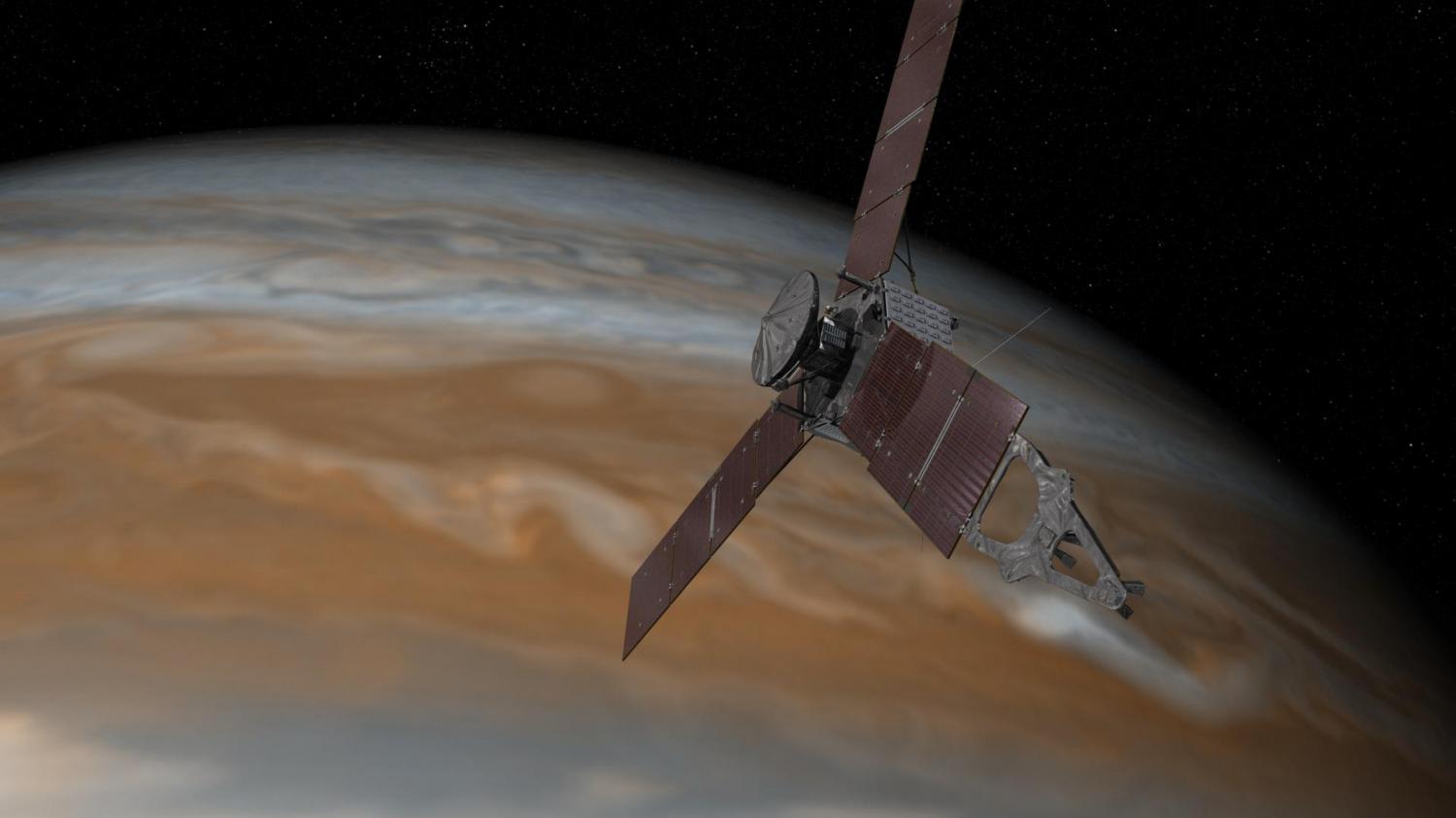
NASA’s Juno spacecraft has captured direct evidence of electrons accelerated to near the speed of light in a turbulent region upstream of Jupiter’s bow shock, revealing a mechanism that may explain how cosmic rays form across the universe. The findings, published Wednesday in the journal Nature, show that the acceleration occurs not at the bow shock boundary itself but within the foreshock — a chaotic zone where magnetic conditions energize particles to extreme velocities.nasa
The research, led by Ben C. Smith of the Johns Hopkins Applied Physics Laboratory, builds on earlier work showing that Earth’s foreshock can produce relativistic electrons. Missions like NASA’s THEMIS had previously observed surprisingly high-energy electrons upstream of Earth’s magnetosphere, generated by foreshock disturbances common in astrophysical shocks. The new Jupiter observations confirm that the same physics operates at the gas giant, but at far greater intensities.aps
Jupiter’s bow shock is vastly larger than Earth’s, and the foreshock scales accordingly. Juno measured electrons reaching energies of at least 1 MeV — exceeding those observed at Earth — with the acceleration scaling in proportion to the size of the planet’s bow shock. A companion News & Views article in Nature noted that on planetary scales, the size of the foreshock region correlates with the size of the bow shock.nasa
The scientists found that this scaling relationship extends well beyond the solar system. The same proportional link between shock size and maximum particle energy matched observations of cosmic rays produced by supernova remnants across the galaxy, where even larger magnetic environments create even faster particles. This suggests a universal physical law governing particle acceleration at collisionless shocks — environments that differ by nearly ten orders of magnitude in scale.nasa
“What this work suggests is that the maximum particle energies at collisionless shocks may be set less by the shock front itself and more by the foreshock,” according to the researchers’ description of the findings.springernature
The discovery reframes how scientists think about cosmic ray origins, a question that has persisted for more than a century since their initial detection. By connecting processes observable within our own solar system to those operating at galactic scales, the Juno data provide a testable framework for understanding nature’s most powerful particle accelerators.nature