








Newsletter Subscribe
Enter your email address below and subscribe to our newsletter

Enter your email address below and subscribe to our newsletter
All voices matter
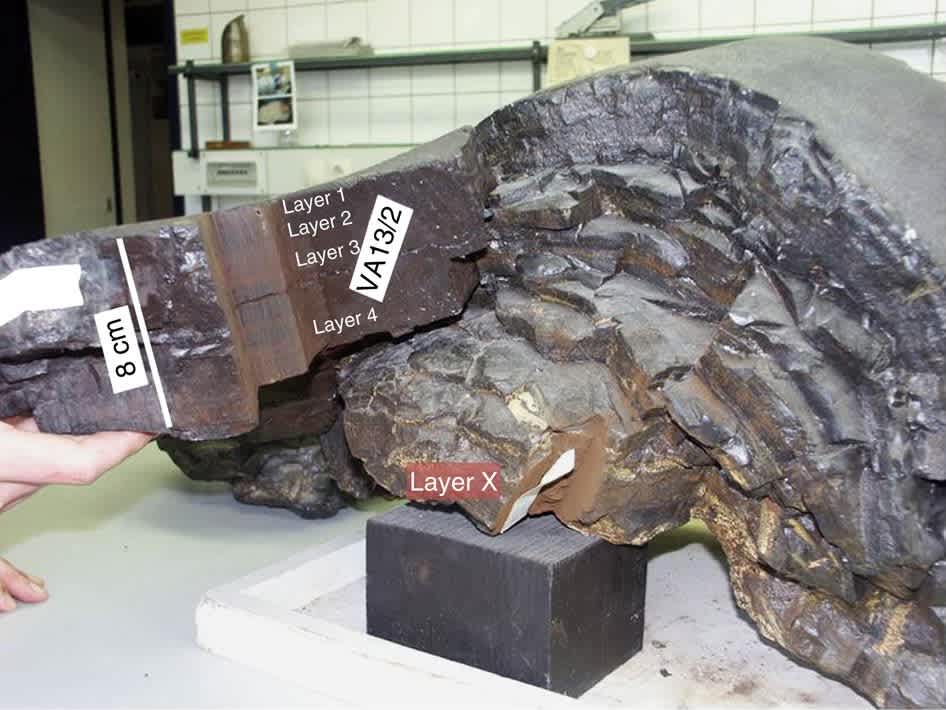
Debris from a cataclysmic cosmic explosion more than 100 million years ago is still falling on Earth today. An international team of researchers has detected hundreds of atoms of plutonium-244 — a radioactive isotope that can only form in the most violent events in the universe — embedded in a slow-growing crust recovered from the depths of the Pacific Ocean.
The study, published this week in Nature Astronomy, was led by Dr. Dominik Koll and Professor Anton Wallner at the Helmholtz-Zentrum Dresden-Rossendorf in Germany, in collaboration with the Australian Nuclear Science and Technology Organisation and the Australian National University.phys
The most likely source of the plutonium is a kilonova — the explosion produced when two neutron stars collide — which are among the brightest objects in the galaxy when they occur. Such mergers are believed responsible for creating and distributing about half of the heavy elements in the universe.anu
The team analyzed a 1.9-kilogram ferromanganese crust sample pulled from the Pacific Ocean floor at a depth of 4,830 meters. Using accelerator mass spectrometry at ANSTO’s Centre for Accelerator Science, they identified a few hundred atoms of plutonium-244, which has a half-life of 81 million years.phys
Crucially, the plutonium was spread evenly throughout the crust layers rather than concentrated at depths corresponding to two known nearby supernovae from the past 10 million years. This showed the plutonium arrived as a continuous rain, independent of those supernova events.anu
To pin down when the source event occurred, the researchers searched the same samples for curium-247, another transuranic element produced alongside plutonium in r-process events but with a much shorter half-life of about 16 million years. They found none.phys
“The only possible explanation is that the cosmic explosion responsible for the plutonium happened so long ago that the curium has already decayed away to practically nothing,” said Dr. Michael Hotchkis, a co-author who conducted measurements at ANSTO.phys
This absence pushed the estimated date of the explosion back to at least 100 million years ago. “It’s mesmerising that we can measure signatures today, in a sample that is tens of millions of years old, of a process from more than 100 million years ago,” Dr. Koll said.anu
The findings have direct implications for understanding how the universe’s heaviest elements are forged. The even distribution of plutonium-244 rules out the two recent nearby supernovae as sources of r-process material and instead points to rarer, more energetic events like neutron star mergers.nanowerk
“We have ruled out several scenarios with this finding, such as a proposed neutron star merger near Earth within the last 10 million years,” Dr. Koll said. “Our data shows that nature is more complicated than that. We need to invest more in models and also in experiments to get to the truth”.anu