



Newsletter Subscribe
Enter your email address below and subscribe to our newsletter

Enter your email address below and subscribe to our newsletter
All voices matter
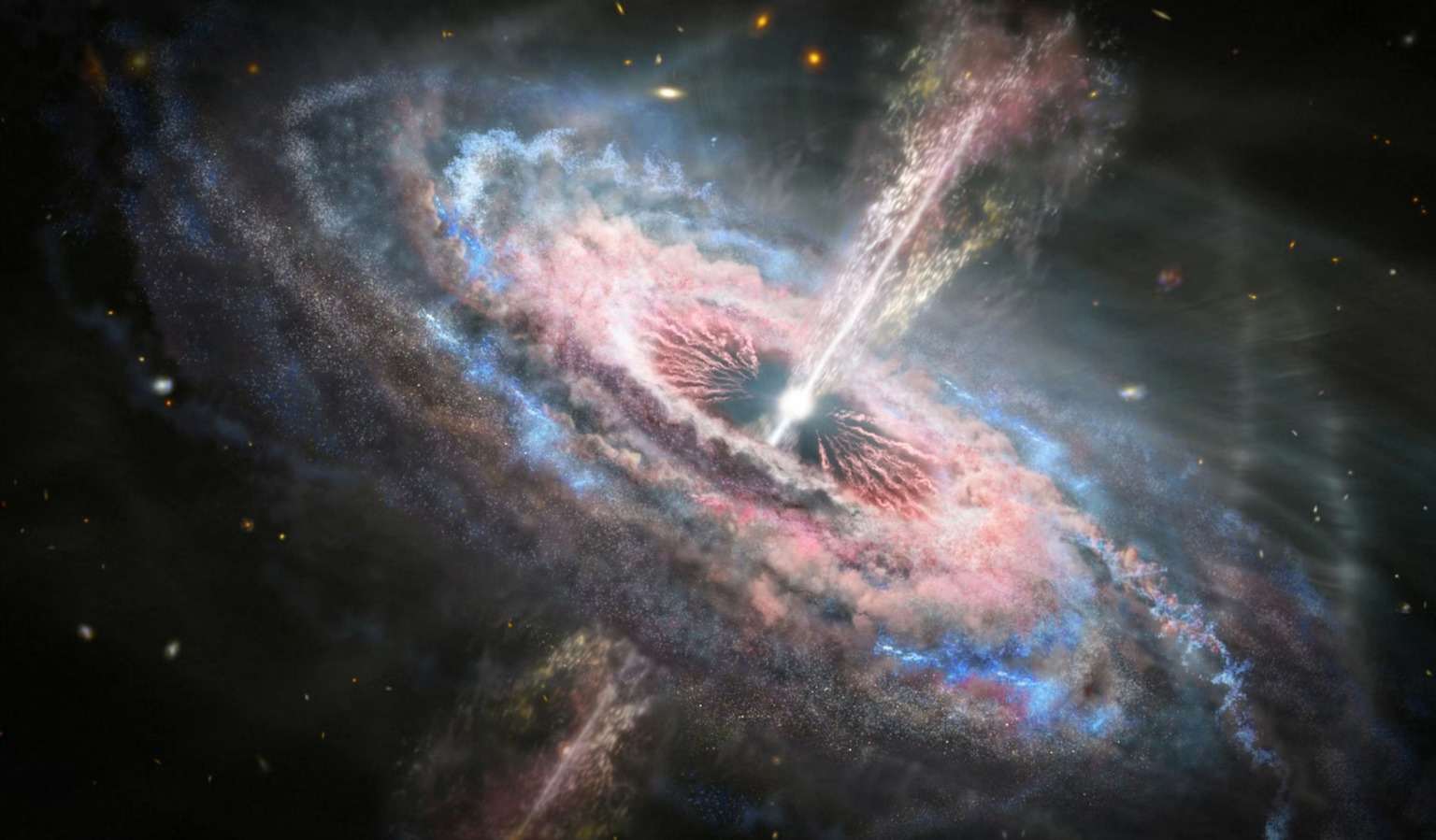
Researchers using NASA’s James Webb Space Telescope have made the first direct mass measurement of a supermassive black hole in the early universe, finding an object so massive relative to its surroundings that it appears to have formed before its host galaxy — upending longstanding assumptions about how the cosmos assembled itself.
The findings, published in Nature and the Monthly Notices of the Royal Astronomical Society, center on Abell2744-QSO1, a compact object that existed just 700 million years after the Big Bang. An international team led by the University of Cambridge used Webb’s Near Infrared Spectrograph to trace the gravitational effects of the black hole on surrounding gas, mapping its velocity and composition pixel by pixel.nasa
By observing Keplerian motion — gas orbiting a central point the way planets orbit the Sun — graduate student Ignas Juodžbalis and collaborators directly calculated the black hole’s mass at roughly 50 million times that of our Sun. The black hole makes up at least two-thirds of QSO1’s total mass, a proportion thousands of times greater than what is observed in nearby galaxies.quantamagazine
“This is a paradigm shift, a total revisiting of the classical scenarios of how black holes form and grow,” said Roberto Maiolino of Cambridge’s Cavendish Laboratory and Kavli Institute for Cosmology, who co-authored the studies.engadget
The gas surrounding the black hole is almost entirely hydrogen and helium, with a metallicity less than 0.5% of the Sun’s — one of the most pristine galactic environments ever measured. This near-absence of heavier elements indicates the black hole existed before significant star formation could enrich its environment.nasa
“It seems that we have found a black hole that does not have a substantial host galaxy and that has predated stellar processes,” Juodžbalis said. “This is very exciting because it is evidence for primordial black holes or direct collapse black holes, which have been theorized but not confirmed.”nasa
Whether QSO1’s black hole formed from a “heavy seed” within the first second after the Big Bang or somewhat later from the collapse of a giant gas cloud, it was almost certainly born big and may now be in the early stages of building a galaxy around it.nasa
Separately, research published in the Journal of Cosmology and Astroparticle Physics by a team at the University of California, Riverside offers a complementary explanation for how such objects could exist. The study proposes that energy released by decaying dark matter could have altered the chemistry of early gas clouds, causing them to collapse directly into black holes rather than forming stars. The mechanism would require each decaying particle to inject only “a billion trillionth the energy of a single AA battery,” according to the researchers.sci
The Cambridge team is now analyzing additional Little Red Dots — the class of small, distant objects to which QSO1 belongs — to determine whether supermassive black holes routinely preceded the galaxies that now surround them.nasa