







Newsletter Subscribe
Enter your email address below and subscribe to our newsletter

Enter your email address below and subscribe to our newsletter
All voices matter
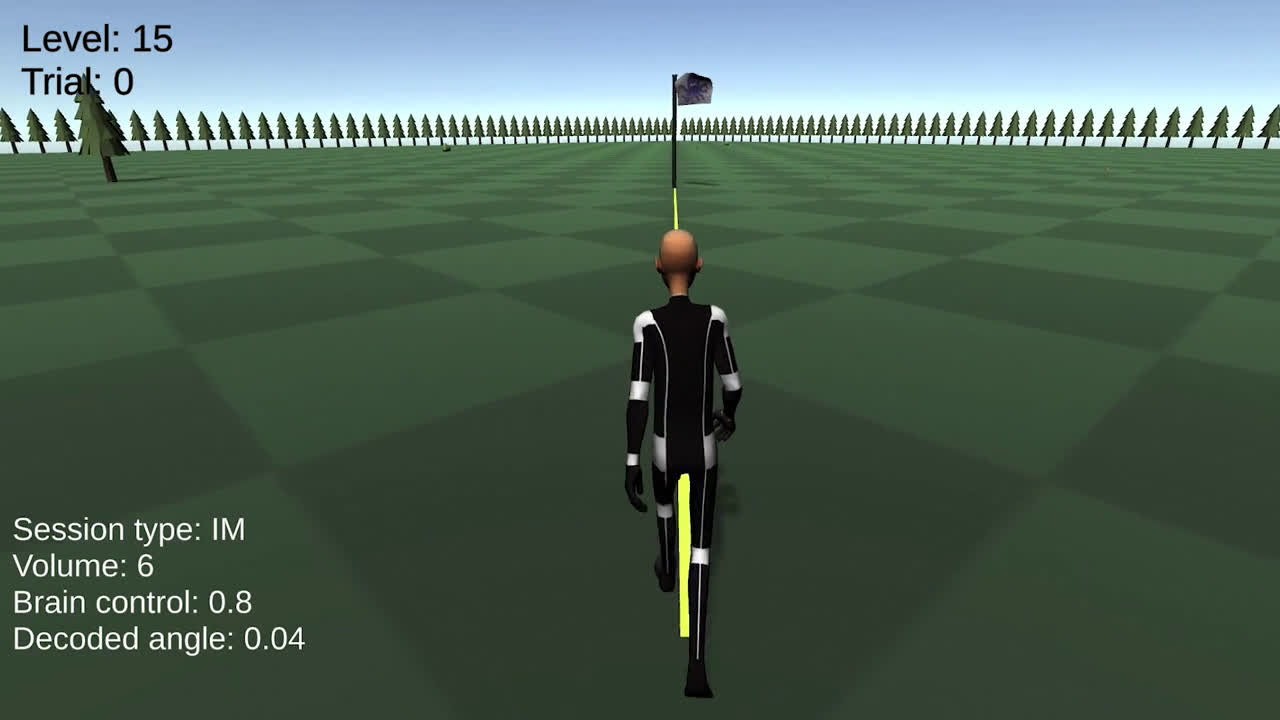
A team of Yale University researchers has built a noninvasive brain-computer interface that allows users to control an avatar in a virtual reality game using only their brain activity — and learn to do so in under an hour. The study, published in Nature Neuroscience on June 9, demonstrates that aligning BCI technology with the brain’s natural geometric structure can dramatically accelerate learning.nature
The research, led by Erica Busch and Nicholas Turk-Browne of Yale’s Department of Psychology, used real-time functional MRI to let participants navigate a virtual world by modulating brain activity in regions supporting spatial navigation. The key insight was leveraging what the researchers call the brain’s “intrinsic manifold” — the naturally occurring geometric structure of neural activity, extracted using a data-diffusion process.nih
When the mapping between brain activity patterns and avatar movement respected this intrinsic manifold geometry, participants quickly regained control after perturbations by reorganizing their neural activity within the manifold. When mappings violated the manifold structure, participants could not learn to control the avatar.nature
The findings suggest that manifold geometry is a fundamental constraint on human learning of complex cognitive tasks in higher-order brain regions. For the growing field of brain-computer interfaces, the results point toward a path for building devices that work with — rather than against — the brain’s natural information-processing architecture.nih
“BCI learning is accelerated by leveraging the naturally occurring geometry, or intrinsic manifold, of brain activity,” the Nature Neuroscience paper states. The work builds on earlier research showing similar manifold constraints in non-human primates using invasive BCIs, but extends the principle to humans using noninvasive neuroimaging for the first time.squarespace
The study’s collaborators include Guillaume Lajoie and Smita Krishnaswamy. Busch, who recently completed her PhD at Yale, will join Vanderbilt University as an assistant professor in 2027.linkedin