








Newsletter Subscribe
Enter your email address below and subscribe to our newsletter

Enter your email address below and subscribe to our newsletter
All voices matter
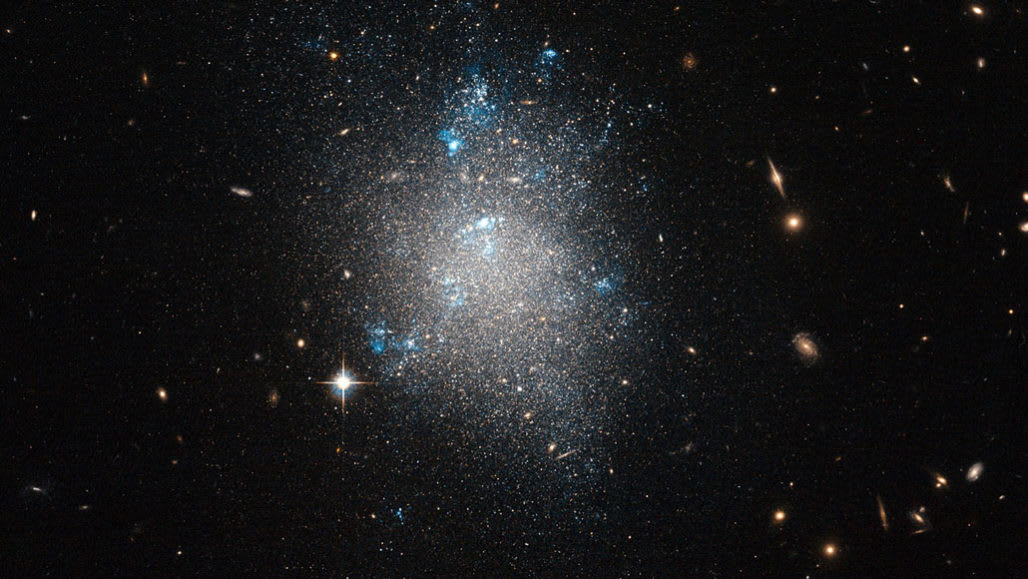
A Yale-led team of astronomers has confirmed that a faint dwarf galaxy 67 million light-years from Earth contains no dark matter, making it the third such galaxy found along an unusual linear trail — and offering some of the strongest evidence yet that dark matter is a physical substance that can be separated from ordinary matter.
The galaxy, NGC 1052-DF9, joins two previously identified dark-matter-deficient galaxies, DF2 and DF4, which were discovered in 2018 and 2019. All three sit in a straight line with seven other galaxies in the NGC 1052 field, a formation never before observed, according to a study published in The Astrophysical Journal.arxiv
“A line of galaxies lacking dark matter has never been seen before,” said Michael Keim, a Ph.D. student in astrophysics at Yale and the study’s first author. “The discovery provides some of the strongest evidence yet that these galaxies formed through an extreme and previously unseen process and offers a rare new window into the nature of dark matter itself.”yale
Using the Keck Cosmic Web Imager at the W. M. Keck Observatory on Maunakea, Hawaiʻi, the researchers measured the motions of stars within DF9 to determine its total mass. They found a stellar velocity dispersion of roughly 6.5 kilometers per second — consistent with the gravitational pull of visible matter alone, estimated at about 140 million solar masses. If DF9 harbored a typical dark matter halo, its mass would exceed 10 billion suns and the velocity dispersion would be far higher.machineherald
The alignment of the three dark-matter-free galaxies points to a single catastrophic origin. In the “Bullet Dwarf” collision scenario, two galaxies smash into each other at extreme speed, stripping gas away from their dark matter halos. That liberated gas then condenses into new galaxies along a linear trail — galaxies born without the dark matter scaffolding that typically holds such structures together.universetoday
DF9 had previously been misidentified as a supermassive black hole before Keim flagged it for deeper analysis during his doctoral work with Pieter van Dokkum, the Yale astronomer who first reported the dark-matter deficit in DF2.yale
Counterintuitively, galaxies lacking dark matter are among the strongest arguments that dark matter is real. If dark matter were merely an artifact of modified gravity, as some alternative theories propose, it could not be physically stripped away from a galaxy. The fact that DF2, DF4, and now DF9 show stellar motions consistent only with their visible mass suggests dark matter is a distinct substance that can be separated from normal matter through energetic collisions.machineherald
“This system shows that stars and galaxies can form outside of dark matter ‘halos’ in extreme events and indicates that dark matter is a physical substance that can act independently of normal matter or gas, challenging alternative theories that dark matter is gravity,” Keim said.yale