







Newsletter Subscribe
Enter your email address below and subscribe to our newsletter

Enter your email address below and subscribe to our newsletter
All voices matter
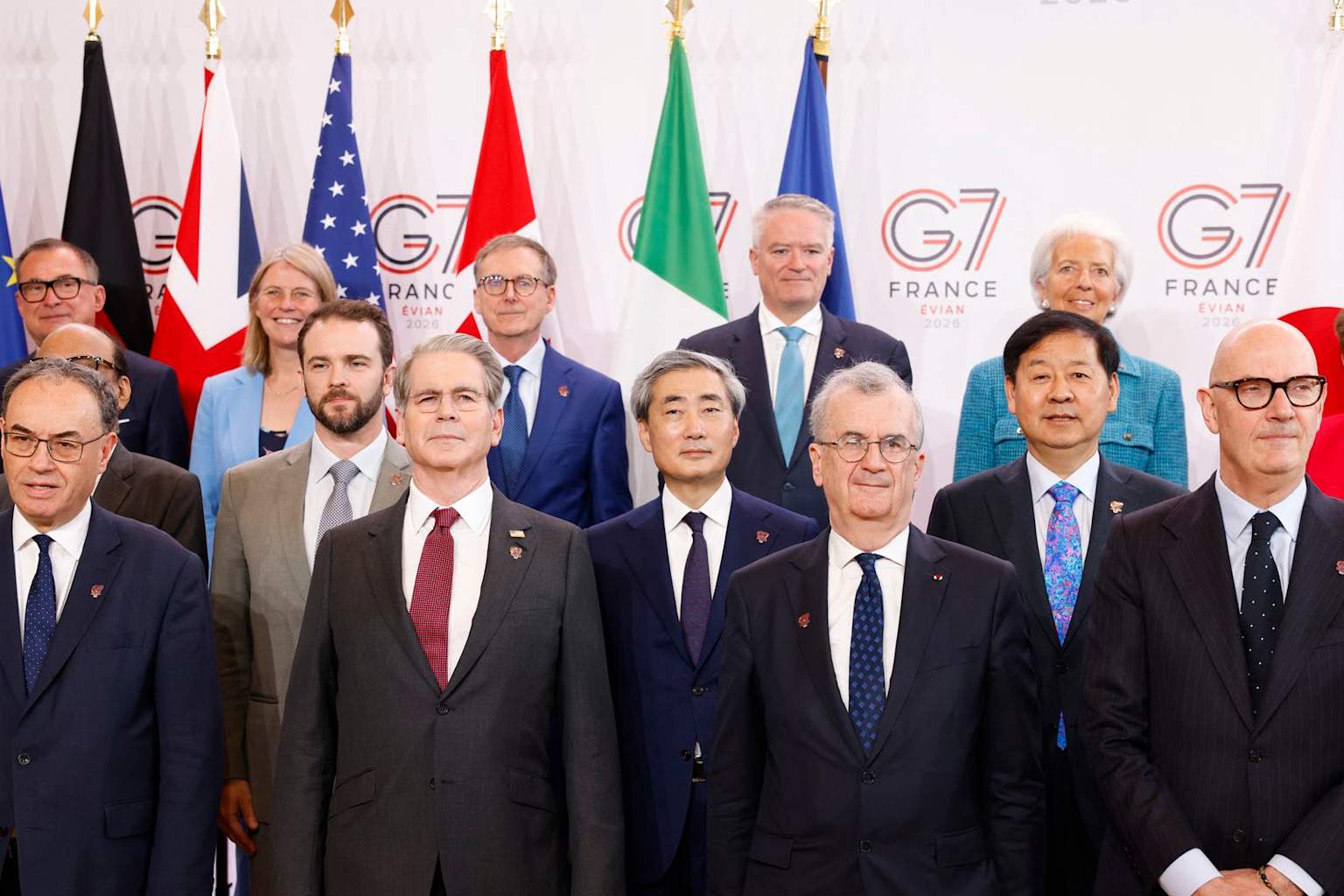
As Asian currencies buckle under the weight of a surging dollar and elevated oil prices, the Group of Seven has declined to pursue a coordinated revaluation of regional exchange rates, leaving central banks across the continent to fend for themselves ahead of next week’s leaders’ summit in Evian, France.
French President Emmanuel Macron on Thursday chaired a video call billed as a “Global Convergence for Growth” conference, bringing together G7 nations, China, India, South Korea, Brazil, and the International Monetary Fund to discuss global economic imbalances. Chinese Vice Premier Zhang Guoqing joined the session in a rare instance of Beijing engaging directly with the G7 format.straitstimes
“Coordination is key, and if they are not addressed through a coordinated approach among the world’s major economies, these imbalances risk unwinding in a disorderly manner, leading to abrupt economic and financial adjustments,” Macron said at the opening of the call. Yet the session produced no commitment to joint currency action. The G7 finance ministers’ communiqué from their May meeting in Paris likewise contained no provisions for a coordinated revaluation of Asian currencies.europa
Writing in Foreign Affairs on the same day, Brad Setser, a senior fellow at the Council on Foreign Relations, and Shahin Vallée argued that the G7 “must engage in currency diplomacy” to address what they called China’s currency manipulation and its distortion of global trade. The article underscored that despite growing consensus around the yuan’s undervaluation — Goldman Sachs has estimated it at roughly 25 percent on a trade-weighted basis — the multilateral machinery has not translated concern into coordinated action.x
The absence of collective action comes as Asian foreign exchange markets face their most sustained pressure in years. The conflict in the Middle East has driven oil prices sharply higher, battering the currencies of net energy importers across the region. The Indian rupee and Indonesian rupiah have fallen to historic lows, while the Philippine peso and Thai baht have also weakened substantially. Central banks from Tokyo to Jakarta have spent billions in reserves attempting to stem the declines, with Bank Indonesia pledging “intelligent interventions” to defend the rupiah.aljazeera
The S&P 500 and broader markets have reflected the uncertainty, while the U.S. dollar index has strengthened on safe-haven flows and higher front-end yields. A MUFG research note this month described the Asian FX outlook as “characterized by divergence rather than a uniform trend,” with oil-sensitive currencies in South Korea, the Philippines, and Thailand bearing the heaviest burden.vnexpress
G7 leaders are set to gather in Evian-les-Bains from June 15 to 17, but expectations for a unified stance remain muted. Nikkei Asia reported that leaders may skip a joint communiqué entirely to avoid highlighting deepening rifts between the United States and its partners. The U.S. Treasury’s January foreign exchange report stopped short of designating any trading partner a currency manipulator, though it warned that China’s “lack of transparency” could lead to future designation.reuters
For now, the question of whether the world’s wealthiest democracies can muster collective leverage on exchange rates — a question that has haunted the G7 since its earliest deliberations — remains unanswered. As Setser and Vallée argued Thursday, the cost of inaction may be borne most acutely by the very Asian economies caught between a strong dollar and expensive oil.foreignaffairs