Newsletter Subscribe
Enter your email address below and subscribe to our newsletter

Enter your email address below and subscribe to our newsletter
All voices matter
Japan’s most sacred Shinto shrine has officially entered its 63rd cycle of reconstruction, marking the continuation of a remarkable 1,300-year tradition that sees Ise Jingu completely rebuilt every two decades. The Associated Press is documenting this latest iteration of the ancient process, which publicly commenced this year with ceremonial tree-cutting and sacred festivals.washingtonpost
The massive undertaking began in May 2025 with the Yamaguchisai ceremony, a drumbeat-accompanied procession where priests in starched robes marched to the inner shrines for prayers marking the start of the rebuilding process. According to Noboru Okada, professor emeritus at Kogakkan University and specialist in Japanese history, “The world where we live and the mountain realm are separate, distinct worlds. Therefore, when people go onto the mountain to cut trees or gather plants, they must first receive permission from the mountain deities”.youtube
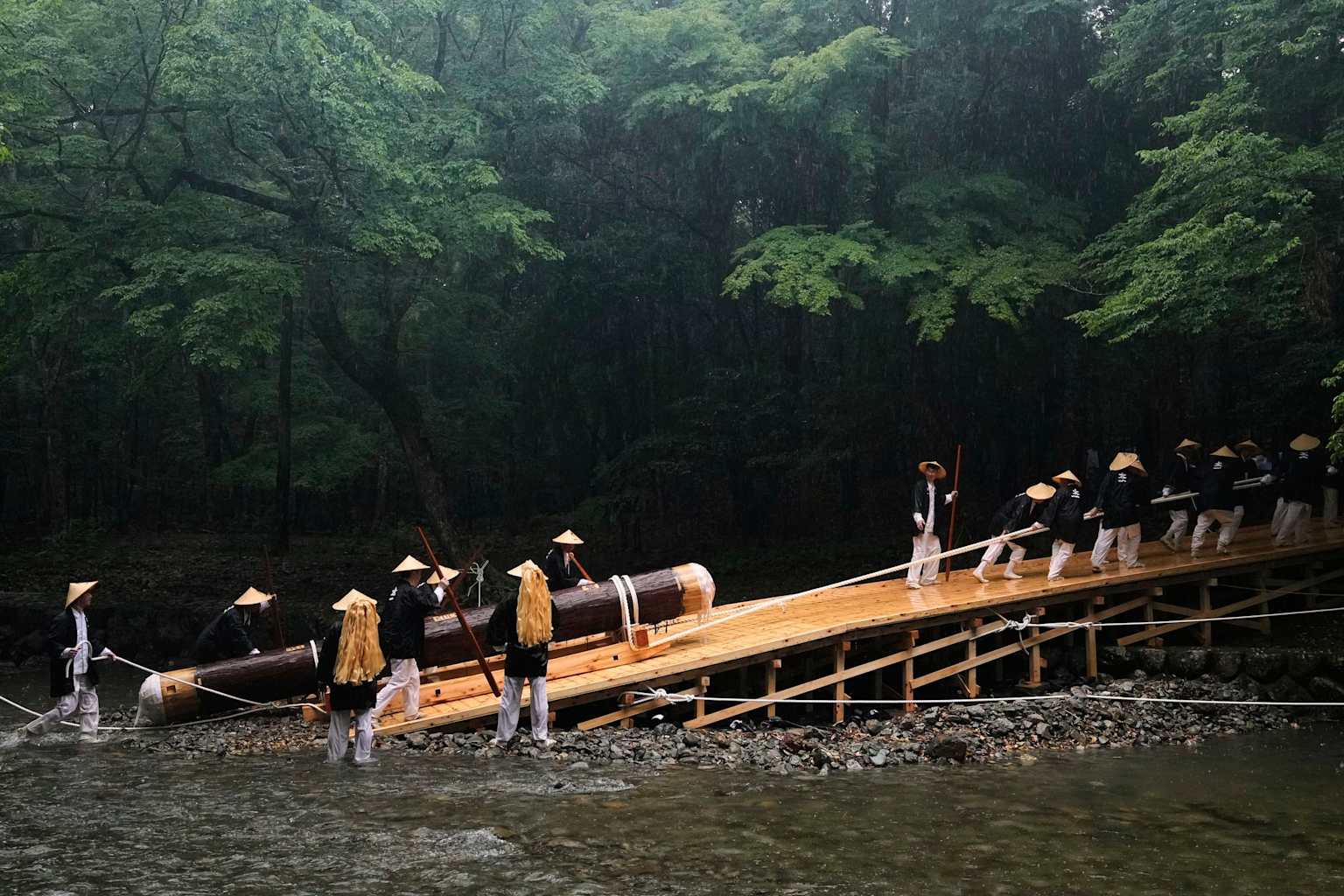
In June 2025, the sacred Misomahajimesai ceremony took place in the Kiso Valley, where woodsmen dressed in ceremonial white used traditional axes to fell 300-year-old cypress trees. The ritual harvesting involved precisely coordinated strikes from three directions, with the head woodcutter shouting “A tree is falling!” as each ancient tree crashed to the forest floor. These sacred logs, each measuring 6.6 meters and weighing 1.5 tons, were subsequently transported through the Isuzu River by dozens of participants chanting traditional songs.citynews
This 63rd cycle will demolish and rebuild all 125 shrine buildings at a cost of approximately $390 million over nine years. The project demands Japan’s finest carpenters, woodcutters, builders and artisans, who dedicate themselves to structures destined for demolition from the moment construction begins. More than 1,500 ceremonial garments and ritual objects will also be recreated using techniques carefully preserved across generations.washingtonpost
The shrine complex includes ten permanent carpentry workshops, with additional craftsmen brought in as needed. Specially cultivated miscanthus reed thatch for the roofs requires eight years of growth to reach the necessary length of over 2 meters. Cypress groves are planted specifically for the reconstruction, with cultivation responsibilities passed down through generations as the trees often outlive individual human lifespans.sfgate
The rebuilding ceremonies attract thousands of spectators, part of approximately 7 million annual pilgrims who visit Japan’s most revered Shinto shrine. Local resident Yuto Nakase, witnessing the ceremonies for the first time, reflected on their rarity: “You can count with one hand the number of times you’ll witness something like this in your lifetime, so I really felt it was a rare and precious sight”.citynews
The shrine’s inner sanctuary is dedicated to Amaterasu, the sun goddess who has been venerated for two millennia in the mountains of Mie prefecture. The tradition embodies the Shinto belief in renewal and the impermanence of all things, with 33 accompanying festivals and ceremonies culminating in a 2033 ritual that will transfer the presiding deity to the newly constructed shrine.washingtonpost
The reconstruction has been interrupted only twice in its 1,300-year history—during civil wars of the 15th and 16th centuries and following World War II. As Harvard professor Yukio Lippit noted, “Ise is unique because of attrition — renewal cycles are difficult to maintain — and because of the vagaries of history; many other shrines that once underwent regular rebuilding have stopped doing so”.citynews