







Newsletter Subscribe
Enter your email address below and subscribe to our newsletter

Enter your email address below and subscribe to our newsletter
All voices matter
Archaeologists in Italy have used artificial intelligence for the first time to reconstruct the appearance of a man killed during the eruption of Mount Vesuvius in 79 AD, offering a vivid glimpse into the catastrophe that buried the ancient Roman city of Pompeii.
The AI-generated image, released Monday by the Pompeii Archaeological Park, depicts a man ducking for cover while holding a large terracotta mortar over his head, with a flaming Vesuvius looming in the background. The man was also carrying a ceramic oil lamp and 10 bronze coins when he died.internazionale
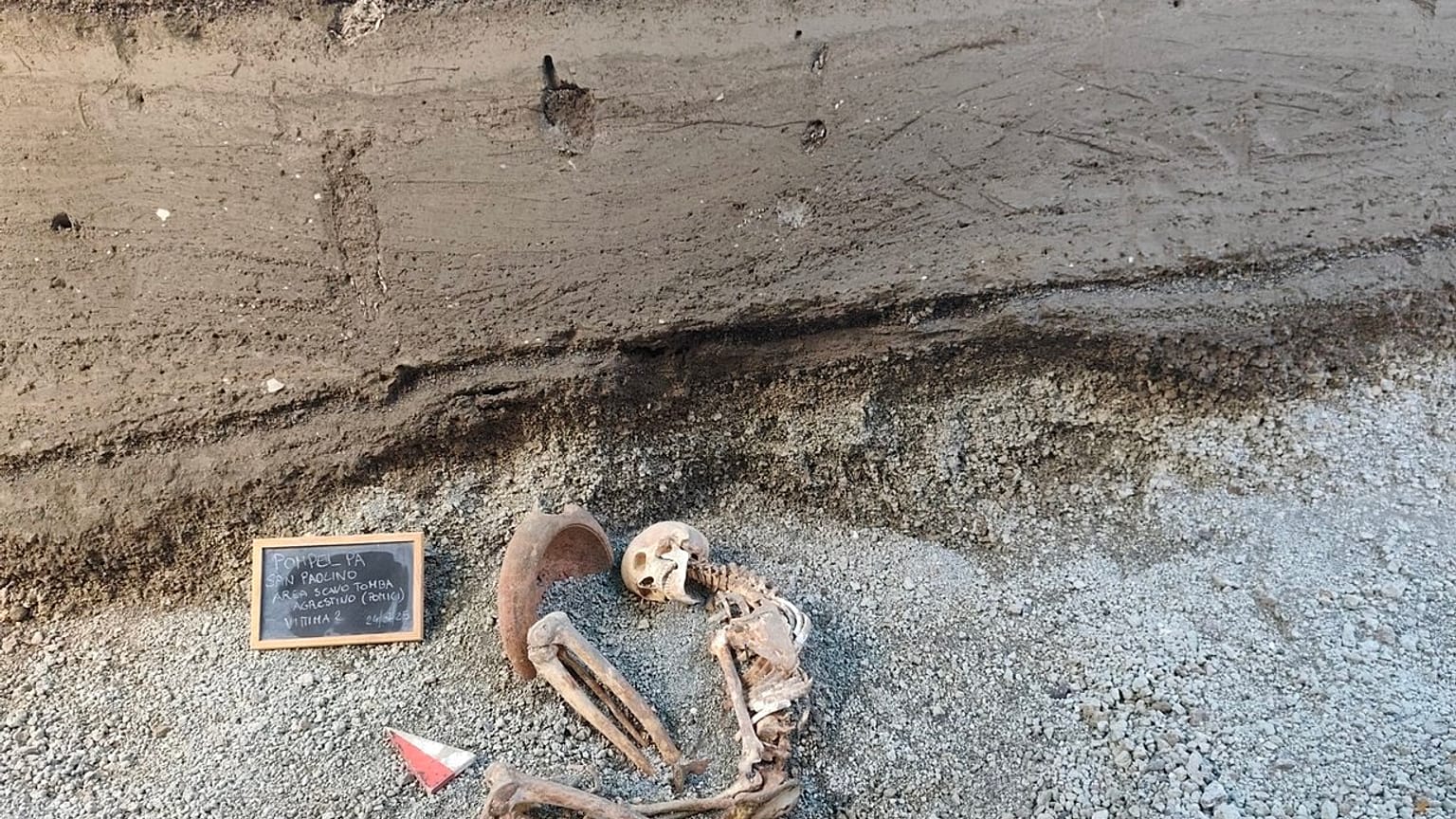
The reconstruction is based on the recent discovery of the remains of a male adult found just outside one of Pompeii’s southern gates, at the Porta Stabia necropolis. Archaeologists believe the man was killed by a shower of volcanic rocks in the early hours of the second day of the eruption, while trying to escape toward the sea. The mortar found next to his body, visibly damaged from impacts, was presumably used as makeshift head protection.finestresullarte
His desperate improvisation echoes firsthand accounts from the eruption. As the Pompeii Archaeological Park noted, the gesture recalls what Pliny the Younger described in a letter: fleeing residents used objects or pillows tied to their heads to defend against falling volcanic material.finestresullarte
The remains were found alongside those of a second man, younger, who likely died later from a pyroclastic current — a searing cloud of ash and toxic gases — while also attempting to flee.finestresullarte
The digital model was created through a collaboration between the Pompeii Archaeological Park and the University of Padua’s Digital Cultural Heritage Laboratory, combining AI software with photo editing techniques. Park Director Gabriel Zuchtriegel called the technology essential for managing the vast scale of Pompeii’s archaeological data: “Only with the help of artificial intelligence will we be able to properly protect and enhance it”.finestresullarte
Luciano Floridi, founding director of Yale’s Digital Ethics Center, offered a measured endorsement. “AI does not replace the archaeologist. Under its control, it expands and deepens its potential,” he said, while cautioning: “AI produces hypotheses, not truth. Hypotheses must be reviewed, discussed, corrected, supplemented, approved. Scientific responsibility is not delegated”.finestresullarte
Jacopo Bonetto, a professor at the University of Padua, echoed the point, calling the project a reflection on AI’s role in archaeology — “a technology that can contribute to the production of interpretive models … but that requires a controlled and methodologically grounded use”.finestresullarte