






Newsletter Subscribe
Enter your email address below and subscribe to our newsletter

Enter your email address below and subscribe to our newsletter
All voices matter
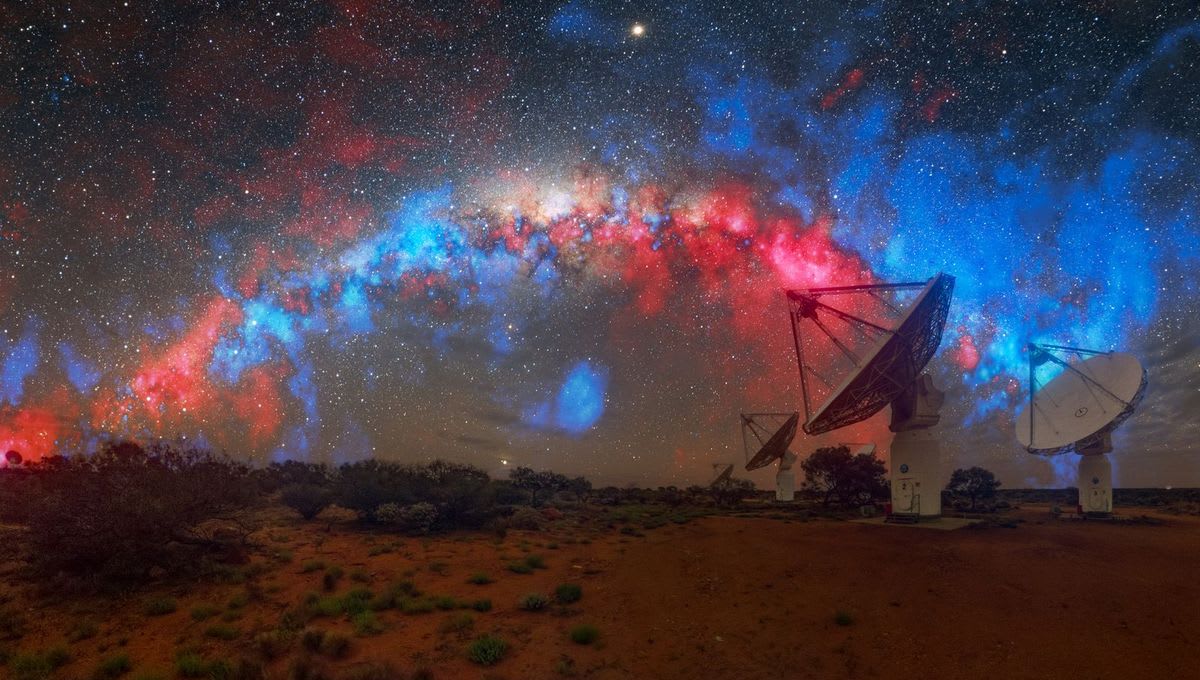
An international team of astronomers has released the largest magnetic map of the universe ever produced, a dataset five times larger than all previous efforts combined that opens a new chapter in the study of cosmic magnetism.
The map, called SPICE-RACS, was created using CSIRO’s ASKAP radio telescope in Western Australia and works by measuring how light twists as it passes through magnetic fields — a phenomenon known as Faraday rotation. Lead researcher Alec Thomson, a commissioning scientist with the SKA Observatory, said the team collected rotation measures from nearly 4 million galaxies detected in the Rapid ASKAP Continuum Surveys.phys
“For the first time, we can investigate fine details of the material between nearby stars, and study a huge number of distant galaxies,” Thomson said.phys
The paper has been accepted by Publications of the Astronomical Society of Australia, and the data is freely available through CSIRO’s data portal.phys
Naomi McClure-Griffiths, the SKA Observatory’s chief scientist and a member of the research team, called SPICE-RACS “a huge leap forward.” She noted that for two decades researchers had been working with essentially the same dataset, which did not even cover the Southern Hemisphere.phys
“We can even potentially find the answer to questions like when did magnetic fields first appear in the universe? We had once thought it would be impossible to answer these questions. I’m excited to say that is no longer the case,” McClure-Griffiths said.phys
The research collaboration behind the map, known as POSSUM (Polarisation Sky Survey of the Universe’s Magnetism), plans to produce even more detailed maps with ASKAP in the coming years. When the SKA telescopes begin early operations later this decade, they are expected to enable astronomers to chart the cosmic web in finer detail and trace the origin of magnetic fields across the universe’s history.iflscience