




Newsletter Subscribe
Enter your email address below and subscribe to our newsletter

Enter your email address below and subscribe to our newsletter
All voices matter
After more than 50 years of searching, astrophysicists at Northwestern University have discovered evidence of a powerful wind blowing from Sagittarius A*, the supermassive black hole at the center of the Milky Way, resolving one of astronomy’s most enduring mysteries.
The findings, published on June 4 in The Astrophysical Journal Letters, reveal a cone-shaped cavity near the black hole where cold gas has been swept away — a telltale signature of hot wind emanating from Sgr A* itself.sciencenews
“We’ve never seen gentle breezes from black holes, but likely that’s what they do most of their lives,” said astrophysicist Elena Murchikova of Northwestern University. “Now, for the first time, we see this gentle breeze from the black hole.”scientificamerican
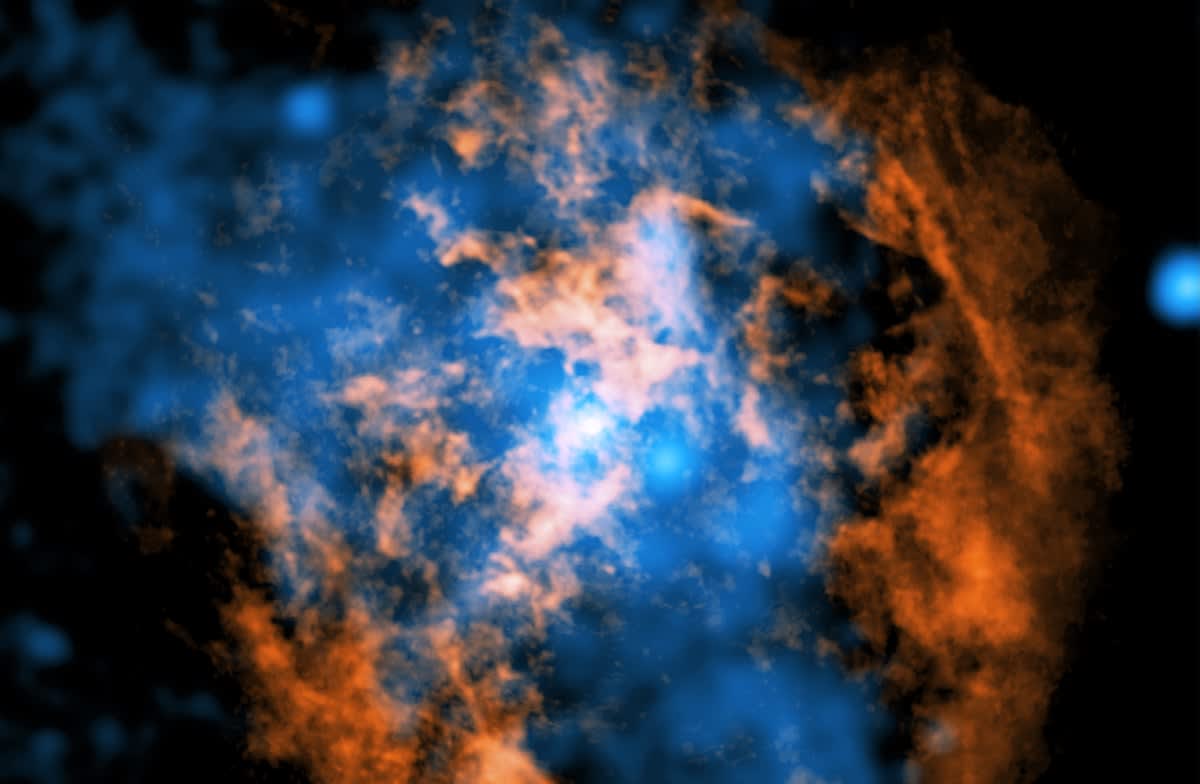
Using the Atacama Large Millimeter/submillimeter Array (ALMA) in Chile, the research team mapped cold carbon monoxide gas in the innermost region surrounding Sgr A*. The data revealed a distinct cone-shaped gap where cold gas was conspicuously absent. When the researchers overlaid X-ray data from the Chandra X-ray Observatory, they found a near-perfect correlation — hot gas filled the exact region where cold gas was missing.science
The wind points out of the plane of the galactic disk at a 45-degree angle and spans about 3 light-years in length. That angle also implies that Sgr A* is spinning out of alignment with the orientation of the galactic plane.northwestern
The team estimated that the energy required to propel hot gas through the cone is roughly equivalent to that of 25,000 suns, which rules out nearby stars as the source. No evident supernovae could have caused the hot gas either, pointing to the black hole itself as the origin.newscientist
Based on how far the wind’s effects extend into a nearby stream of ionized gas, the astrophysicists estimate it has been active for at least 20,000 years.phys
The discovery suggests that even quiet, relatively inactive black holes like Sgr A* interact with their surroundings through such winds. Astronomers have long observed powerful winds from actively feeding black holes in distant galaxies, but detecting the far gentler breeze from our own galaxy’s dormant black hole had remained elusive since the 1970s. The findings imply that hot winds stir up surrounding cold gas, sweeping it away and sometimes even out of a galaxy — a process that can quench star formation.sciencenews