




Newsletter Subscribe
Enter your email address below and subscribe to our newsletter

Enter your email address below and subscribe to our newsletter
All voices matter
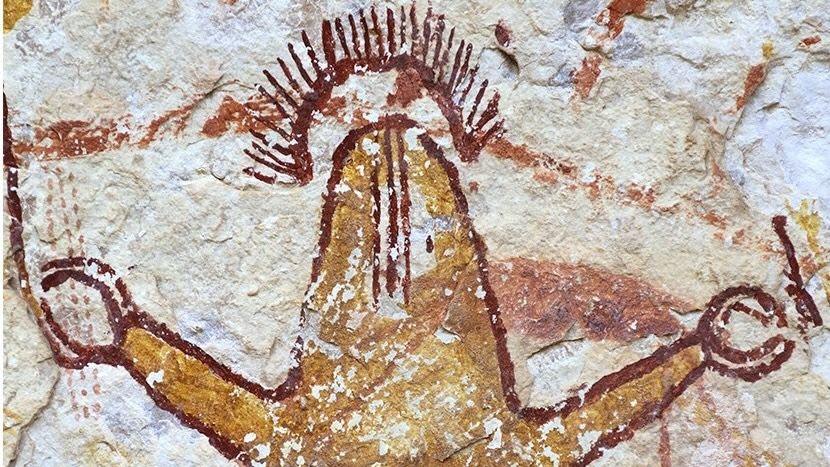
Researchers have solved a decades-old mystery surrounding ancient rock murals in the Lower Pecos Canyonlands of southwest Texas, establishing that Indigenous artists maintained an artistic tradition for more than 4,000 years across approximately 175 generations. The findings, published November 26 in Science Advances, provide the most comprehensive chronology for any rock art province in the Americas.science
The breakthrough came through an innovative dating technique that analyzed organic carbon from deer bone marrow used by ancient artists as a paint binder, according to Karen Steelman of the Shumla Archaeological Research and Education Center. The team obtained 57 direct radiocarbon dates and 25 indirect oxalate dates from 12 sites, determining that the oldest murals date back 5,760 to 5,385 years ago, while the most recent were created 1,370 to 1,035 years ago.artnet
“Dating them has proven difficult, since their mineral pigments aren’t carbon-based,” Steelman explained. The research team used plasma oxidation to extract organic carbon without harsh chemical treatments, and took control samples of unpainted rock to ensure the dated material came solely from the paint.nih
The study revealed that individual murals, some measuring up to 500 feet long and 50 feet high, were created during single painting events rather than accumulated over centuries as previously believed. “Radiocarbon dates within many of the murals clustered so closely as to be statistically indistinguishable, suggesting that they were produced during a single painting event as a visual narrative,” said Carolyn Boyd, a professor at Texas State University and study co-author.artnet
Using digital microscopy to examine overlapping paint layers, researchers discovered that artists consistently followed a strict color sequence: black, then red, then yellow, and finally white. This sequence corresponds to creation myths found in later Indigenous cultures, where black represents the void, red the sun, yellow dawn, and white noon.nih
The Pecos River style murals depict human-like and animal-like figures alongside enigmatic symbols that Boyd and her colleagues interpret as expressions of an ancient cosmovision—a comprehensive worldview that influenced later Mesoamerican agricultural societies. “The canyons of Southwest Texas house a vast ancient library containing hundreds of painted visual texts authored by 175 generations, preserving sacred stories and indigenous knowledge,” according to a Texas State University announcement.science
The research team identified 134 sites containing diagnostic Pecos River style motifs, including “power bundles,” “crenelated arches,” and “rabbit-eared headdresses”. The murals’ consistency across four millennia, despite environmental changes and technological shifts, suggests they served as a means of transmitting sacred knowledge through a cultural keystone landscape.nih