







Newsletter Subscribe
Enter your email address below and subscribe to our newsletter

Enter your email address below and subscribe to our newsletter
All voices matter
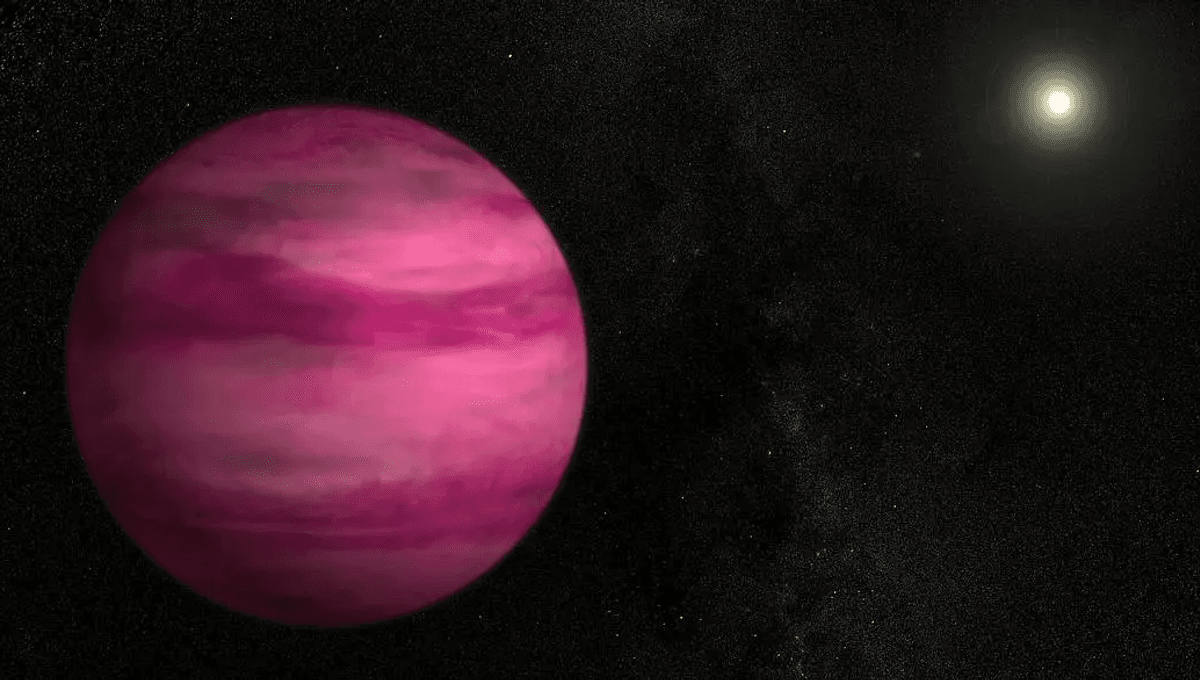
New observations from the James Webb Space Telescope have uncovered clouds made of salt swirling through the atmosphere of GJ504b, a mysterious magenta-hued world discovered more than a decade ago. The finding, published Wednesday in the Astronomical Journal, provides some of the first direct evidence for salt clouds in a cold object’s atmosphere — a phenomenon scientists theorized more than 15 years ago but had never confirmed.northwestern
GJ504b, nicknamed the “Pink Planet,” orbits a sun-like star roughly 57 light-years from Earth in the constellation Virgo. Discovered in 2013, the object has long frustrated astronomers because it is too faint and cold for ground-based telescopes to dissect its light. At just 290 degrees Celsius — roughly the temperature of a bread-baking oven — it is far cooler than most directly imaged exoplanets, which typically burn at 500 to 1,000 degrees Celsius.iflscience
A Northwestern University-led team, headed by postdoctoral researcher Aneesh Baburaj, used JWST to capture the companion’s spectrum in about two hours — a feat that had eluded ground-based observatories even after entire nights of observation.northwestern
“When we finally obtained its spectrum, it immediately looked interesting,” Baburaj said. “But once we started digging deeper into the data, we realized it was not like anything we have analyzed before.”northwestern
The spectrum revealed water vapor, methane, carbon dioxide, ammonia, and other molecules. But when the team fed these data into atmospheric models, the results were physically implausible — until they added clouds. Of three cloud types tested, salt clouds composed of compounds like potassium chloride and zinc sulfide fit best, subduing the signatures of molecules hidden in the atmosphere’s deeper layers.iflscience
The new study also revised GJ504b’s vital statistics. Previous estimates placed its mass at roughly four times Jupiter’s, but the JWST data suggest it is about 25 times Jupiter’s mass and between 2.5 billion and 4 billion years old — placing it near the boundary between giant planets and brown dwarfs.northwestern
The techniques developed for this study could help astronomers probe even colder and fainter objects in the future. Jupiter, for instance, hosts ammonia-ice clouds that remain beyond current observational reach, but the detection of GJ504b’s salt clouds suggests researchers are closing the gap.northwestern
“This is the first time we’ve found that salt clouds are critical to explaining the spectrum of an object,” Baburaj said. “It’s a good reminder to account for clouds in our models.”iflscience