







Newsletter Subscribe
Enter your email address below and subscribe to our newsletter

Enter your email address below and subscribe to our newsletter
All voices matter
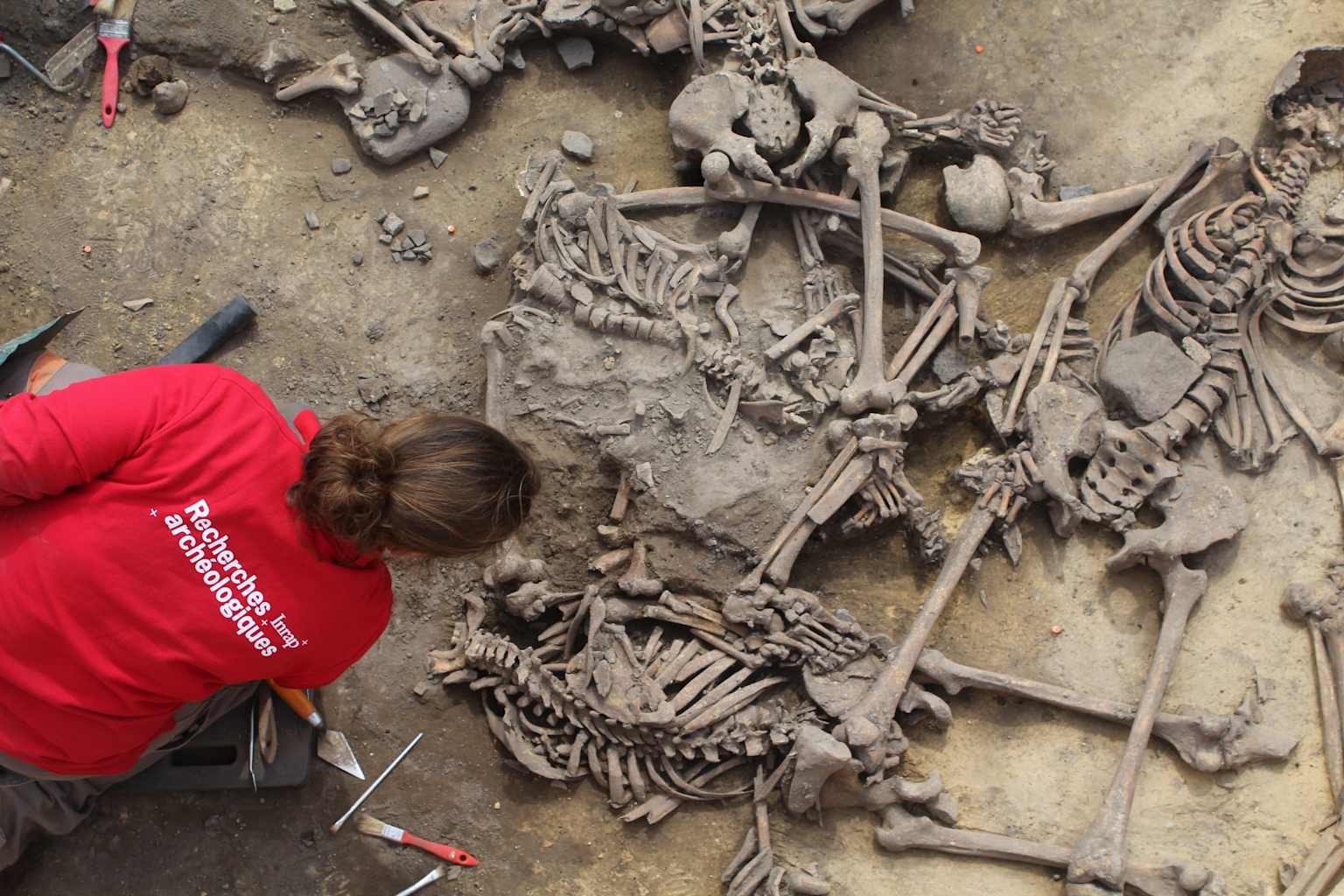
Archaeologists have unveiled new details about a violent Neolithic massacre that occurred more than 6,000 years ago in northeastern France, revealing evidence of brutal victory celebrations where invaders were tortured, mutilated, and their severed limbs taken as trophies.
The discovery, detailed in a study published Wednesday in the journal Science Advances, provides fresh insights into prehistoric warfare practices through the analysis of 82 skeletal remains found in burial pits at the Achenheim and Bergheim archaeological sites. The research was led by Dr. Teresa Fernández-Crespo, a distinguished researcher at the University of Valladolid in Spain, and colleagues who used advanced isotopic analysis to distinguish between attackers and victims.livescience
The archaeological evidence reveals a pattern of extreme violence that went far beyond what was necessary to kill. According to Live Science, the remains show that victims’ lower limbs were fractured to prevent escape, entire bodies displayed blunt force traumas, and some skeletons bore piercing holes suggesting the bodies were placed on structures for public display after torture and execution.livescience
“We believe they were brutalized in the context of rituals of triumph or celebrations of victory that followed one or several battles,” Fernández-Crespo told Live Science. The burial pits, located in the middle of settlements, suggest these acts were “a public theater of violence intended to dehumanize the captive enemies in front of the entire community”.livescience
The most distinctive evidence comes from severed left arms and hands found in the pits, which researchers believe were taken as trophies in one of the earliest well-documented instances of martial victory celebration in prehistoric Europe. This represents what the study calls an “unprecedented intensity of violence to the body that can only be understood in a context of torture, mutilation and dehumanization of the victim”.livescience
The breakthrough in understanding came through multi-isotope analysis of teeth and bones, which revealed the chemical signatures of where people grew up and what they consumed. The isotopic analysis showed that those who suffered mutilation came from outside the local area, possibly from around Paris, while victims who were not mutilated were locals who likely died defending their territory.livescience
The chemical signatures also indicated that the mutilated group ate food from different areas and moved around frequently, suggesting they were part of an invading force. This finding represents a major advancement in prehistoric archaeology, as one expert noted it “made it possible to achieve something as important as distinguishing between captives and attackers in prehistoric contexts of interpersonal violence as far back as the Neolithic”.livescience
The violence occurred during a period of widespread unrest across Europe between 4300 and 4150 BCE, coinciding with what experts describe as a continent-wide crisis period. Detlef Gronenborn, an archaeology professor at the Leibniz Center for Archaeology in Germany, explained that this era was characterized by “considerable unrest Europe-wide and is linked to a period of high climate volatility” that culminated around 4100 BCE.livescience
The discovery adds to mounting evidence of Neolithic warfare in the region, where people lived in fortified settlements and archaeological evidence shows pottery from the Paris area appearing in greater amounts in northeastern France. The findings demonstrate that even in humanity’s earliest agricultural societies, conflict could reach levels of systematic brutality that would persist throughout human history.livescience