






Newsletter Subscribe
Enter your email address below and subscribe to our newsletter

Enter your email address below and subscribe to our newsletter
All voices matter
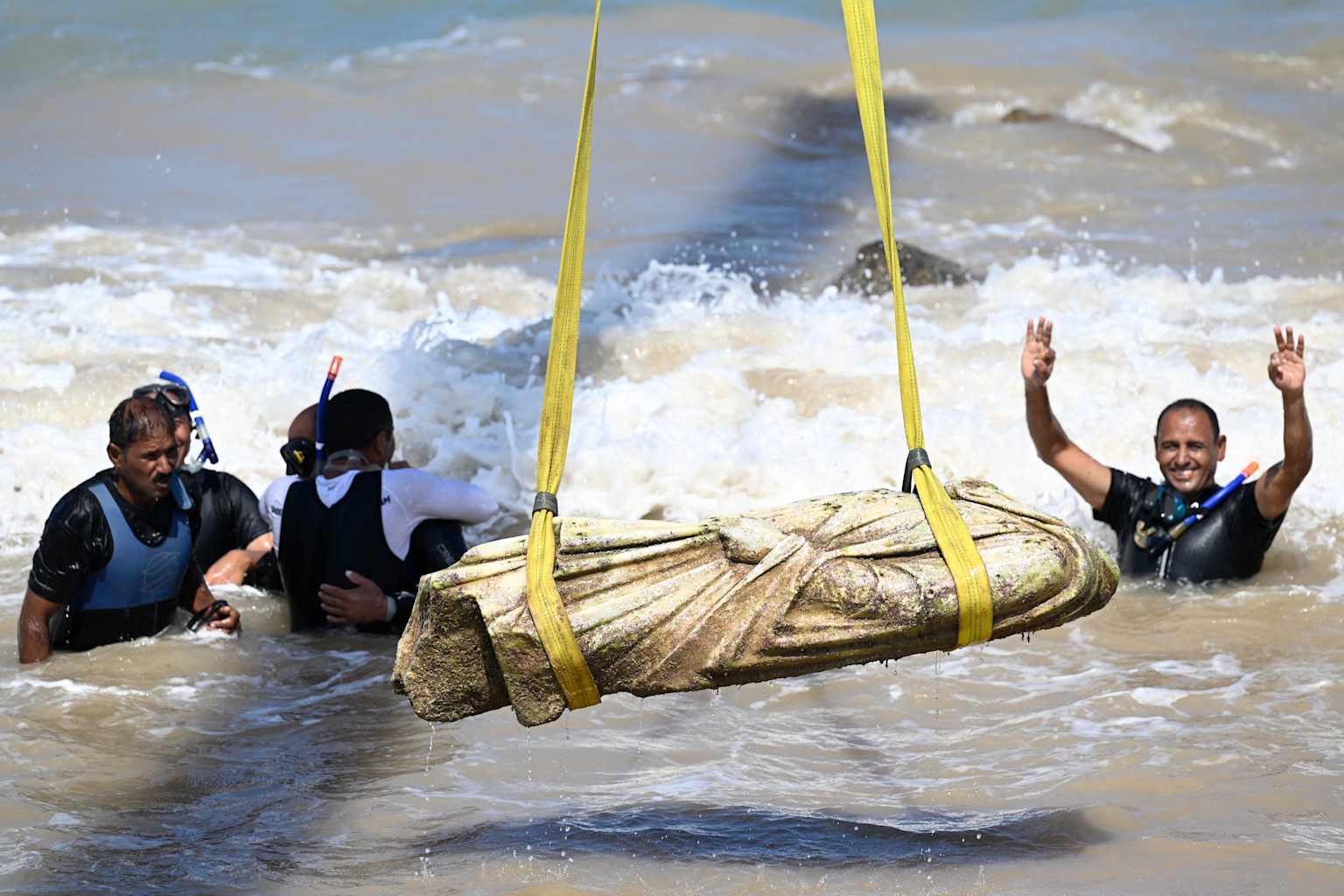
Egypt successfully recovered three ancient artifacts from the Mediterranean Sea on Thursday, marking the country’s first underwater antiquities retrieval operation in 25 years. The massive sculptures, including a sphinx bearing the cartouche of Pharaoh Ramses II, were hoisted from the seabed near Alexandria using cranes as divers celebrated the historic achievement from the shore.
The operation took place at Abu Qir Bay, where archaeologists believe the artifacts originated from the ancient city of Canopus, a major trading hub during the Ptolemaic and Roman periods that was submerged over two millennia ago due to earthquakes and rising sea levels.
Tourism and Antiquities Minister Sherif Fathi witnessed the retrieval alongside Alexandria Governor Ahmed Khaled and senior military officials, according to Egypt’s Ministry of Tourism and Antiquities. The ceremony marked a pivotal moment in Egypt’s efforts to preserve its underwater cultural heritage.greekreporter
“There’s a lot underwater, but what we’re able to bring up is limited, it’s only specific material according to strict criteria,” Fathi told reporters, emphasizing that most artifacts will remain submerged as part of Egypt’s underwater heritage.arabnews
The three recovered pieces include a colossal quartzite sphinx statue with Ramses II’s royal cartouche, a headless granite sculpture from the late Ptolemaic era, and a white marble statue of a Roman nobleman. Mohamed Ismail Khaled, Secretary-General of the Supreme Council of Antiquities, confirmed this was the first such operation since 2000.news
The recovery site contains extensive underwater ruins including limestone buildings that likely served as temples, residential areas, and commercial structures. Archaeologists have also identified reservoirs, stone-carved ponds for water storage and fish cultivation, and a 125-meter dock that operated from Ptolemaic through Byzantine periods.greekreporter
Canopus, along with neighboring Thonis-Heracleion, succumbed to natural disasters that caused ground liquefaction beneath their grand structures. These cities were prominent Mediterranean trading centers before Alexandria’s founding in 331 BCE.newcriterion
The recovery coincided with the opening of “Secrets of the Sunken City” exhibition at Alexandria National Museum, showcasing 86 artifacts retrieved from Abu Qir Bay since 2000 by the European Institute for Underwater Archaeology. The exhibition, running for six months, represents Egypt’s first temporary display dedicated exclusively to underwater discoveries.dailysabah
French archaeologist Franck Goddio, who discovered Thonis-Heracleion in 2000, estimates only 5% of these ancient cities have been explored.hilti