







Newsletter Subscribe
Enter your email address below and subscribe to our newsletter

Enter your email address below and subscribe to our newsletter
All voices matter
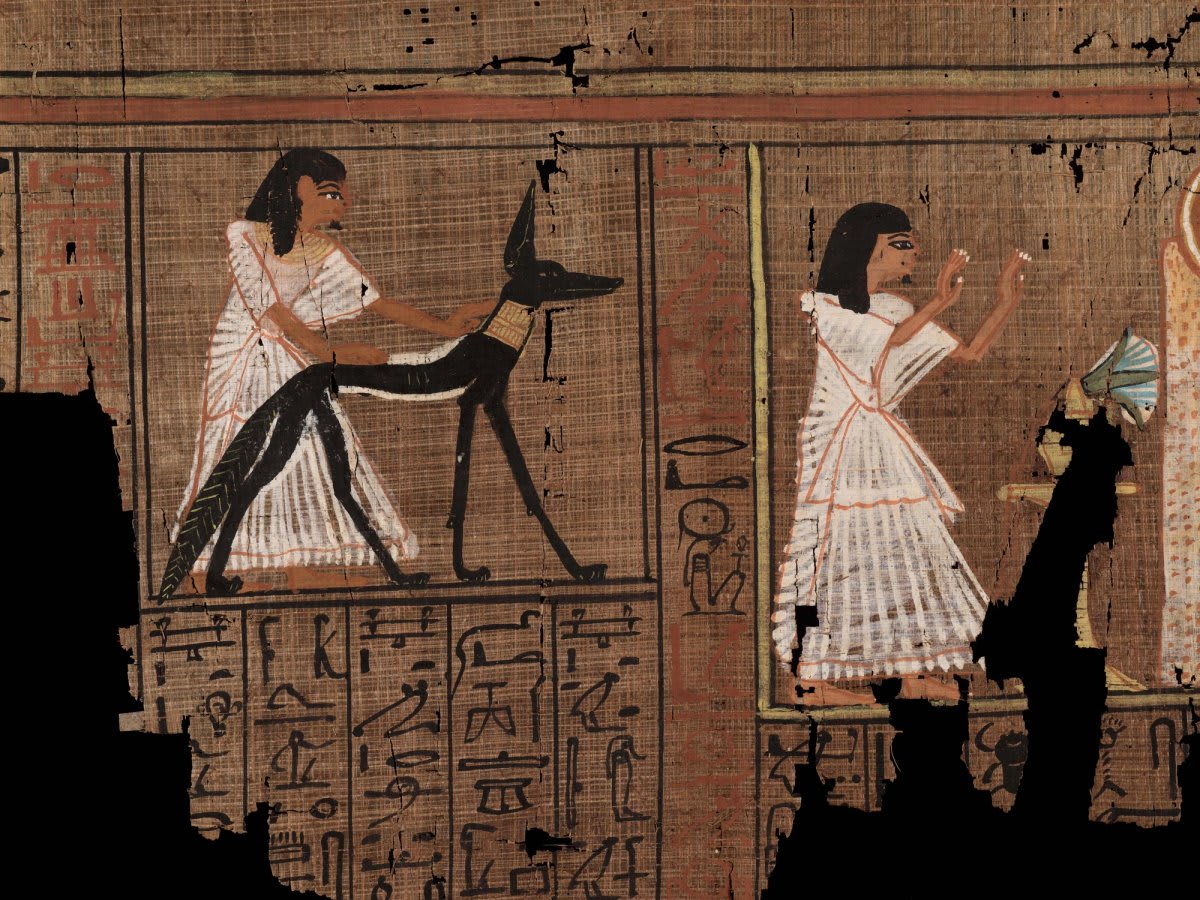
Researchers at Cambridge’s Fitzwilliam Museum have discovered that ancient Egyptian craftspeople used an early form of white-out to correct errors on papyrus documents, applying bold strokes of white paint to slim down a jackal figure that someone apparently deemed too fat.
The discovery was made as museum staff prepared one of the best-preserved Egyptian scrolls for the “Made in Ancient Egypt” exhibition, which runs through April 12. The papyrus in question is a copy of the Book of the Dead — an anthology of spells believed to guide the deceased through the afterlife — created for Ramose, a senior royal scribe who lived in the early 13th century B.C.E.cam
In a scene depicting Ramose with his hands along the body of what is most likely the jackal-headed god Wepwawet, a deity associated with war and the protection of the dead, museum staff noticed dense white lines painted along both sides of the jackal’s body and across the upper halves of its back legs.artnet
“It’s as if someone saw the original way the jackal was painted and said, ‘it’s too fat; make it thinner,'” said Helen Strudwick, senior Egyptologist at the museum and the exhibition’s curator.artnet
Using infrared photography and a 3D digital microscope, researchers determined that the white paint was a mixture of calcite and huntite, both white carbonates — distinct from the paint used for Ramose’s flowing robes, which contained only huntite. Flecks of yellow orpiment pigment were also detected, likely added to help the correction blend with the papyrus, which would have been far paler in antiquity than it appears today.artnews
Strudwick noted she has found the same technique on papyri held at the British Museum and the Egyptian Museum in Cairo. “When I have pointed them out to curators, they’ve been astonished,” she said. “It’s the kind of thing that you don’t notice at first.”artnet
Ramose’s Book of the Dead was unearthed in 1922 at Sedment in Middle Egypt by archaeologist William Flinders Petrie and entered the Fitzwilliam’s collection shortly after. Once estimated to have stretched more than 60 feet in length, its hundreds of fragments were painstakingly reassembled by a specialist conservator in the early 2000s. It is considered one of the finest surviving examples of a Book of the Dead from ancient Egypt — and now, one that reveals the very human impulse to fix a mistake before anyone notices.artnet