Newsletter Subscribe
Enter your email address below and subscribe to our newsletter

Enter your email address below and subscribe to our newsletter
All voices matter
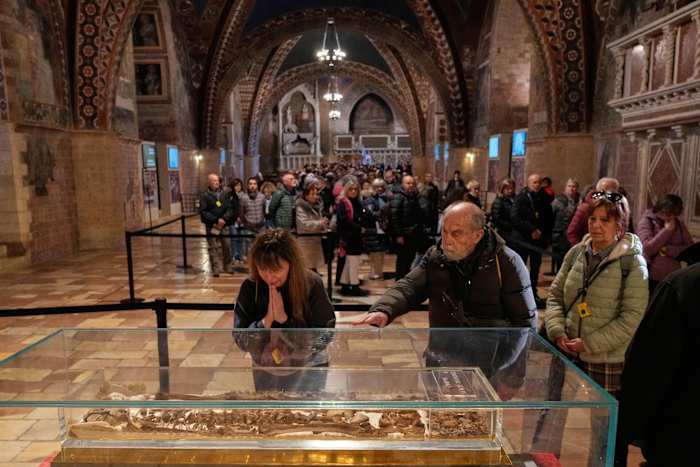
The skeletal remains of St. Francis of Assisi went on public display Sunday for the first time in history, drawing pilgrims from around the world to the hilltop Umbrian town where the medieval friar lived and died nearly 800 years ago. Encased in a nitrogen-filled plexiglass container inscribed with the Latin words “Corpus Sancti Francisci” — The Body of St. Francis — the bones are now visible inside the lower Basilica of St. Francis of Assisi, where they will remain until March 22.rte
Nearly 400,000 people have registered in advance to view the relics, and Assisi Mayor Valter Stoppini estimates the total could reach half a million before the exhibition ends. A volunteer force of 400 has been recruited to guide visitors through the medieval city’s cobblestone streets and into the basilica, where the remains sit within a bulletproof, anti-burglary glass case monitored by 24-hour surveillance cameras.apnews
The decision to exhibit the remains publicly marks the culmination of a centuries-long history of secrecy and protection. St. Francis died on the evening of October 3, 1226, and was initially buried in a small Assisi church, San Giorgio. Pope Gregory IX canonized him within two years and laid the cornerstone for a basilica to house his tomb. But on the eve of the body’s transfer, Francis’s trusted aide, Brother Elias, secretly buried the remains inside the basilica, fearing they would be stolen. The bones remained hidden and unmarked until 1818, when excavations uncovered the tomb and Pope Pius VII confirmed the identity of the remains.ksat
While the relics were briefly shown in 1978 when they were placed in their current plexiglass case, that was not a public exhibition. Periodic inspections by Franciscan friars over the years have focused on conservation, not veneration.nytimes
The monthlong display is something of a logistical challenge for the small city. Stoppini said a month was “the maximum he could ask” of Assisi’s residents, especially after a surge of pilgrims in 2025 tied to the canonization of Carlo Acutis, the Catholic Church’s first millennial saint, by Pope Leo XIV. Acutis, who died of leukemia at 15, is buried in a different Assisi basilica, and his popularity among young Catholics has transformed the town into a destination for a new generation of faithful.apnews
Security on Sunday morning was tight but discreet, with pilgrims passing through metal detectors and police deploying sniffer dogs and plainclothes officers. Fra Giulio Cesareo, a Franciscan friar, said the “damaged” and “consumed” state of the bones showed that St. Francis “gave himself completely” to his life’s work. What struck many early visitors was how slight the skeleton appeared — consistent with accounts of Francis’s frail health and austere life of poverty.rte
“It’s remarkable that after 800 years, Francis is still alive,” said Brother Marco Moroni, custodian of the convent. “He’s not just a relic; he’s vibrant and resonates with people’s hearts.”nytimes